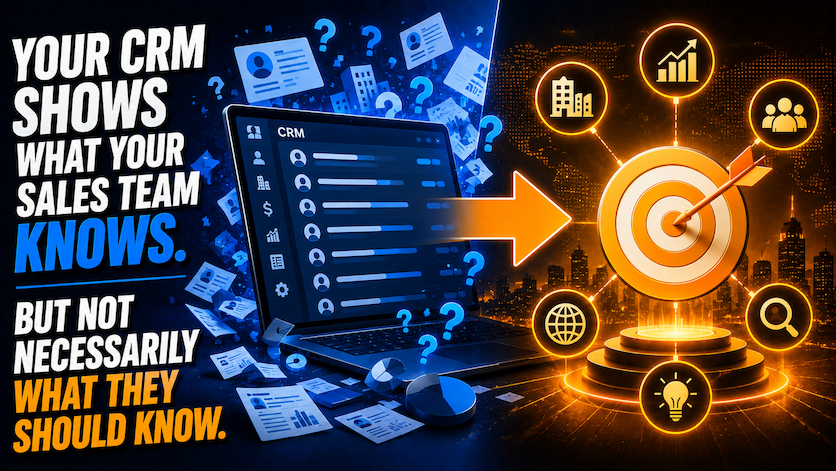
Information is not the same as insight
Anyone looking to learn about a company today almost automatically starts with Google. This makes sense, since hardly any other tool allows you to find company websites, press releases, product pages, job postings, technical documents, or other publicly available information so quickly.
This is enormously valuable for traditional research. Within just a few minutes, you can often find out significantly more about a company than any corporate database could ever contain. We can see which products are offered, which markets are targeted, which locations exist, and what changes have been publicly announced.
Nevertheless, this alone does not constitute commercial intelligence.
That’s because commercial intelligence doesn’t begin where information is found. It begins where that information is used to draw business-relevant connections.
That is precisely the difference between searching and gaining insight.
Google finds information, but not automatically the meaning behind it
Let’s take a manufacturer of automation solutions that is looking for new target customers. Using Google, you can very quickly find out which companies have production facilities, what machines they manufacture, or what job openings are currently listed.
For example, one search result might show that a company is expanding its production space. Another result might lead to a job posting for automation engineers. At the same time, the company’s website features a new generation of products designed to enable higher production volumes.
Google has thus provided several interesting pieces of information.
However, what Google doesn’t automatically answer is whether this information is related and what business implications might arise from it.
Perhaps the expansion is intended solely for warehouse space. Perhaps the company is looking for an automation engineer for a completely different business area. Perhaps the new product generation has no impact at all on existing production.
Only when we contextualize this information, compare sources, and relate it to our own offerings can we form a robust hypothesis.
It is precisely this step that distinguishes information from commercial intelligence.
A search engine does not know our needs profile
Google fundamentally does not know why a particular company might be of interest to us. The search engine does not have an in-depth understanding of our offerings, does not automatically understand which technical problems we solve, and does not know which situations typically lead to a need for our solution.
Of course, we can formulate search queries with ever-greater precision. We can search for companies with specific manufacturing processes, products, or technologies and add additional terms related to growth, investments, or staffing shortages.
However, the more complex the need becomes, the more difficult the search becomes.
For example, a provider of industrial measurement technology could not simply search for “companies in need of measurement technology.” The actual need could arise wherever specific quality requirements are increasing, new materials are being used, production processes must meet tighter tolerances, or additional documentation requirements are introduced.
The companies affected rarely describe this situation using the exact terms the provider is searching for.
This means that traditional search queries reach a natural limit.
Commercial Intelligence therefore does not focus exclusively on finding the right search terms. It first seeks to understand which business and technical situations are relevant to its own offerings.
Only then does the Need Profile emerge, which allows information to be evaluated meaningfully.
Companies speak their own language
Furthermore, companies do not describe their situation in the language of their potential suppliers.
A manufacturing company rarely states on its website that it currently has a need for a specific automation solution. Instead, it might report on rising production volumes, the expansion of a facility, or difficulties in recruiting qualified employees.
A manufacturer of process plants does not necessarily state that it needs a new supplier for temperature control. It might describe a new plant system with higher performance requirements.
To someone with industry knowledge, the significance of such information may be obvious. But for a standard search, these are initially unrelated pieces of content.
This is a fundamental problem with keyword research.
The language of the market and the language of one’s own offering do not always align.
Commercial intelligence must therefore operate semantically. It must be able to understand that different phrasings can refer to the same technical or business situation.
Only then does the search for terms become a search for meaning.
A single search result is rarely the whole story
Another problem is that relevant company information is scattered across many sources.
The website describes the product portfolio. A press release reports on the expansion of a location. A job posting shows which skills are currently being developed. A technical PDF provides insights into the technologies used, while an industry article explains the market into which the company intends to expand.
Each source tells only part of the story.
Google can lead us to these sources, but the real work begins afterward. Information must be compared, placed in chronological order, and checked for contradictions. Only then can a complete picture emerge from several individual observations.
Especially when dealing with larger target markets, this manual effort quickly becomes a problem.
An experienced sales representative can thoroughly research ten companies—perhaps even fifty. However, if the same approach is applied to hundreds or thousands of companies, what starts as good research quickly turns into a massive capacity problem.
This is exactly where the value of AI in the context of commercial intelligence comes into play. It does not replace the source, but rather helps evaluate many sources simultaneously and structure the relationships between them.
Quality doesn’t depend on how much we find
Google easily gives the impression that more information automatically leads to better research.
In practice, the opposite can happen.
The more information available about a company, the harder it becomes to determine which pieces are actually relevant. A large industrial company might publish hundreds of press releases, thousands of job postings, and extensive technical documentation.
However, the sales department only needs a small portion of that.
What matters isn’t knowing as much as possible about a company, but finding the information that influences a business decision.
Has anything changed that’s relevant to our proposal? Could this potentially lead to a problem or a project? Does this company generally fit our need profile, and is the information we’ve found current enough to be relevant today?
Without this assessment, research quickly becomes mere information gathering.
Commercial intelligence, on the other hand, seeks to derive decision-relevant insights from information.
Timeliness also affects the significance of information
Another challenge of traditional research lies in time.
Search engines can continue to prominently display very old information. An article about the launch of a new production line may be several years old, while a job posting may date from a different phase of the company’s development.
Anyone who merely compiles this information can quickly create a picture that, while based on genuine sources, no longer accurately describes the current situation.
For commercial intelligence, therefore, it is not only important what was found, but also when it happened.
An investment made in 2021 may now be just part of the existing infrastructure. A site expansion announced three weeks ago, on the other hand, may indicate a development that is just beginning.
When we observe companies over time, the quality of the insights we gain also changes. Individual pieces of information become part of a broader trend, and it is only from this temporal perspective that opportunity signals can reveal their true significance.
Insight arises only through context
This brings us to the crucial difference.
Information answers a question such as:
“The company is building a new facility.”
Insight asks further:
“What does this new location mean for the company, and why might this change be relevant to us?”
Perhaps a new production facility will be established there. Perhaps new technologies will be implemented. Perhaps this will change the supply chain or require additional capacity.
It is precisely this connection between corporate information and one’s own offerings that creates commercial relevance.
Commercial Intelligence therefore doesn’t work like a larger search engine.
It’s an additional layer above the search.
Sources provide information. AI can help interpret and connect this information. The Need Profile provides the context used to assess its relevance. The sales team ultimately decides whether this could lead to an opportunity.
It is only the interplay of these layers that transforms research into a basis for sales decisions.
Google remains important, but takes on a different role
This does not mean that Google is losing its importance for modern sales.
On the contrary.
Search engines remain one of the most important ways to find publicly available information. They index websites, documents, and news, thereby making a large portion of the information base accessible in the first place.
What is changing are the expectations placed on this tool.
Google is excellent at guiding us to information. However, the search engine is not designed to understand our individual commercial landscape or to determine, for every company it finds, whether a relevant opportunity could develop from it.
This task goes beyond that.
One could therefore put it this way:
Google helps us find information. Commercial intelligence helps us understand which pieces of that information are important for a sales decision.
One does not replace the other.
But they each solve different problems.
Commercial Intelligence begins where search ends
This difference becomes particularly clear when we look at a larger market.
Suppose a company wants to research 5,000 potential target customers. With Google, it would theoretically be possible to research information for each individual account. In practice, however, the effort would be enormous, because each account would have to be examined using different search terms, and the information found would then have to be sorted manually.
Commercial Intelligence aims to systematically map out precisely this process.
It’s not about simply generating more search results for every company. The system is designed to understand which information is relevant to the respective need profile, which trends are emerging, and which accounts therefore deserve special attention.
This shifts the focus of the research.
We no longer want to find as much information as possible.
We want to identify the right connections as early as possible.
And that’s exactly what makes AI interesting for sales.
Conclusion
Google has revolutionized corporate research. It has never been easier to find information about products, technologies, locations, employees, or corporate developments.
However, the problem with modern sales work lies less and less in mere access to information.
The real challenge lies in identifying, from the enormous volume of publicly available information, what is relevant to one’s own business.
Commercial Intelligence therefore adds context to the search. It connects different sources, takes their evolution over time into account, and evaluates them based on your own needs profile.
This transforms “We’ve found some information” into a much more meaningful statement:
“We understand why this information might be relevant to us.”
And this changes not only the way companies conduct research.
It also changes the role of salespeople.
In the next post: How the role of sales is changing
As AI takes on more and more research tasks, continuously monitors companies, and highlights relevant developments early on, the work of the sales team will inevitably shift as well.
The salesperson of the future will need to spend less time searching for companies and manually compiling information. At the same time, their ability to assess situations, understand contexts, and use the insights gained to develop a relevant conversation with the customer will become more important.
This gives rise to a new role.
Sales will become less of a researcher and more of a decision-maker, advisor, and conversation partner.
That is exactly what the next post is about:
CI-030: How the Role of Sales Is Changing.
👉 Recommendation
In addition to manual research, we’ve developed automated tools for you:
bloo.research— Find the right B2B companies in minutes
bloo.radar - Find out what your competition—
—is going to do next before they do it.
🚀 Next Step
If you want to not only understand AI but also implement it in a structured way within your company, then:
👉 Learn more about our AI training program:
https://bloo.school
👉 Learn more about our Smart Market Fit offerings:
https://bloola.com/smf - The Smart Market Fit Course
https://bloola.com/smf-system - The Smart Market Fit System for Businesses
👉 Or learn more about our consulting and automation solutions:
https://bloola.com