Products, Technologies, Processes, Supply Chains, and Investments
Just a few years ago, company research in sales was primarily a matter of structured data. Anyone looking for new target customers relied on criteria such as industry, region, number of employees, revenue, or specific technological features. Anything beyond that had to be researched by the sales representative themselves. They would visit websites, read product descriptions, look for references, review technical documents, job postings, and press releases, and try to piece together as complete a picture as possible.
The real problem was rarely that the information didn’t exist. Much more often, it was scattered across different sources, phrased differently, and not intended to be analyzed by a sales system. In industrial companies in particular, this creates major information gaps between what a company database knows about a business and what can actually be inferred from its products, technologies, and activities.
Artificial intelligence is transforming precisely this aspect of the work. Modern AI can not only search existing data fields but also read large amounts of unstructured information, recognize contextual relationships, and correlate information from different sources. This makes it possible, on a larger scale, not only to classify companies based on who they are, but also to better understand what they do, how they operate, and the direction in which they are evolving.
From Company Data to Company Context
Let’s imagine a manufacturer listed in a database as a mechanical engineering company with about 300 employees. This information is certainly helpful for an initial market segmentation. For a sales representative who wants to decide whether this company is actually a promising customer, however, it is hardly sufficient.
Only the company’s actual content provides the real context. For example, the website might reveal that the company develops complete systems for the food industry. Product descriptions show that these systems involve heating, dosing, transporting, and cooling. Technical documentation specifies certain temperature ranges, while job postings simultaneously seek PLC programmers and commissioning engineers. A recent news item also reports on the expansion of the assembly area.
Each piece of information describes only a small part of the picture. Taken together, however, they paint a much more detailed picture of the company. We begin to understand which products are offered, which technologies are likely relevant, and where changes may currently be taking place.
This is precisely where the strength of AI-powered business analysis lies. It no longer views information exclusively in isolation but seeks to develop a common business and technical context from it.
Product portfolios become roadmaps of potential needs
Product portfolios are particularly valuable because companies typically describe their own products in great detail. After all, customers need to understand which functions, features, and applications are offered. As a result, product pages, brochures, and technical data sheets often contain information that is extremely valuable for sales research.
AI can first use such content to identify which product groups a company offers and for which applications they are intended. However, the analysis only becomes truly interesting once technical relationships are derived from this information. A manufacturer of battery systems requires different components and technologies than a manufacturer of packaging machines. A supplier of laboratory equipment, in turn, has different requirements than a manufacturer of industrial pumps.
The product portfolio can thus provide clues as to which materials, components, or technical solutions might be relevant to the company in principle. This does not necessarily mean that a specific supplier is actually used there. However, it does yield a plausible hypothesis about which supplier relationships would make technical sense.
This is exactly what the sales team finds interesting. They don’t just get a company name—they also get a possible reason why this company might be a good fit for their own offerings.
Manufacturing processes and technologies are also becoming increasingly visible
The process works similarly when analyzing manufacturing processes. Some companies list processes such as CNC milling, injection molding, laser cutting, or automated welding directly on their websites. Others describe their production more indirectly, for example through machine lists, technical references, or the qualifications sought in job postings.
AI can consolidate such clues and attempt to develop a picture of the actual production landscape from them. For example, if a company offers complex precision components made of titanium, is seeking several CAM programmers, and features automated machining centers on its website, this provides a much more accurate picture than the industry designation “metalworking.”
The same applies to technologies. Job postings often specify particular control systems, software solutions, or machine platforms. Product documentation describes interfaces, while partner pages or reference projects provide additional clues about the systems in use. This information can reveal, at least in part, what kind of technological environment a company might have.
For many B2B providers, this information is crucial. A company may have a problem that is fundamentally a good fit but still be an unsuitable customer if its existing technical infrastructure is incompatible with the provider’s solution. Conversely, an existing technology may indicate that a company is already organizationally and technically prepared for certain next steps.
Supply chains cannot be fully visualized, but can be partially reconstructed
The analysis becomes even more interesting when it comes to supply chains. Companies generally do not publish complete lists of their suppliers and purchasing relationships. Nevertheless, supply chains leave traces, because products, production processes, certifications, and technical requirements allow conclusions to be drawn about what types of components or materials are needed.
For example, a manufacturer of complex systems will need specific control, drive, or sensor technology. A producer of high-quality electronic enclosures requires different materials and manufacturing processes than a manufacturer of chemical processing plants. Product data, partner websites, technical documentation, and publicly known collaborations can provide additional clues.
AI can develop a plausible structure from this information, but should not confuse it with confirmed knowledge. The distinction is important. A reputable analysis should not claim that a company will definitely purchase a specific component if there is no reliable source to support this. However, it can explain why a certain component category is likely relevant based on the product design and technical requirements.
It is precisely this distinction between substantiated information and plausible inferences that will become a key quality indicator of AI-powered sales research in the future.
AI becomes particularly valuable when it detects changes
So far, we’ve mainly looked at what a company is today and what technical prerequisites exist. For sales, however, it becomes particularly exciting when AI can also detect what is changing.
A company expands a location, simultaneously seeks additional production engineers, and announces a new product generation shortly thereafter. Each of these pieces of information might be relatively unspectacular when viewed in isolation. Combined, however, they form a trend that may indicate new capacities, changed processes, or additional technology needs.
Similarly, a series of job postings can indicate that a company is building new capabilities. If, over the course of months, the company is seeking additional roles in automation, development, or commissioning, this could signal a technological shift. If production space is being expanded or new products are being announced at the same time, this interpretation gains further weight.
This makes time a distinct dimension of corporate analysis. Not only is the current state relevant, but so is the question of how the company is changing over the course of weeks and months.
For commercial intelligence, this dynamic is often more decisive than a static company profile.
A company can be uninteresting today and highly relevant tomorrow
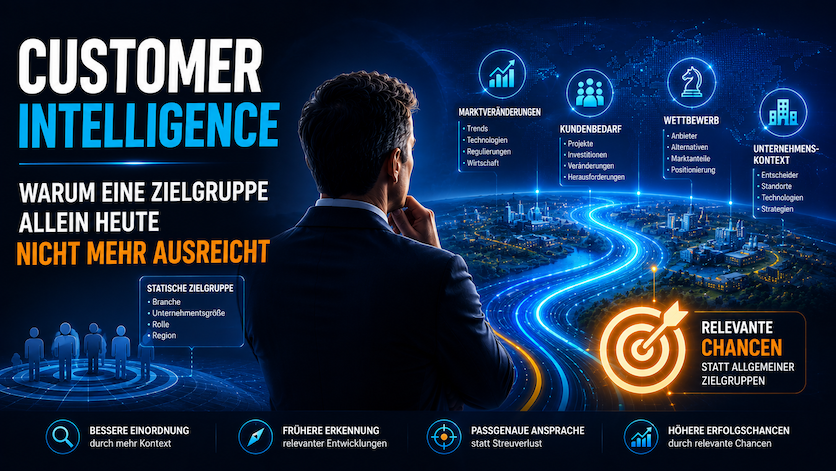
This temporal perspective fundamentally changes the concept of a target market. In traditional databases, a company often appears virtually unchanged for years. Industry, location, and number of employees change relatively slowly.
The actual business situation, on the other hand, can change completely within a few months. A company might win a major contract, introduce a new product line, build an additional production facility, or shift its technological focus. Suddenly, a need arises that did not exist before.
Consequently, it is no longer sufficient to identify target customers once and then continue working with the same list indefinitely. An account that does not fit our need profile today can quickly transform into a highly promising opportunity.
AI can therefore help not only with the search in the long term, but also with the continuous monitoring of a commercial space. The real question is then no longer exclusively which companies are a good fit today, but which companies are currently developing in a direction that is relevant to us.
However, AI can only recognize what is publicly visible
Amid all these possibilities, one limitation is particularly important. AI has no secret access to a company. It does not know any information that is neither published nor derivable from reliable sources.
If a company does not name its suppliers, AI cannot know them for certain. If a production line is not described, its exact technical specifications remain unknown. And if a job posting is several years old, it cannot be used to reliably infer the current situation.
This may sound obvious, but it’s often forgotten in practice. Precisely because AI can formulate arguments very convincingly, it’s easy to get the impression that a plausible interpretation is a confirmed fact.
That is why good commercial intelligence systems should consistently distinguish between observation and interpretation. The statement that a company has announced a new production facility is observable information. The assumption that this might create a need for automation is an interpretation. The claim that the company will soon purchase a specific automation solution, on the other hand, would not be justified without further evidence.
This distinction builds trust in the results.
Quality lies not in the score, but in the reasoning
This is precisely why I consider raw scores to be problematic if they are not explained.
A sales representative gains little insight from the fact that a company has a Fit Score of 87 percent. What matters is why this company was deemed a good fit.
A good AI-powered analysis should therefore make it clear what information was found, what sources it came from, and what conclusions were drawn from it. If a company is expanding its production space, seeking several automation engineers, and simultaneously announcing a new generation of products, this provides a much more transparent rationale than an abstract number.
The sales representative can then review this information, evaluate it, and decide whether it warrants a follow-up conversation.
This is precisely where it becomes clear once again that AI does not replace sales. Above all, it takes over the time-consuming task of searching for and structuring information. Commercial evaluation remains a task for which knowledge of customers, the market, and the company’s own offerings is crucial.
Data only becomes sales insight through the Need Profile
A new production facility isn’t automatically of interest to every provider. A new product may be highly relevant to a materials manufacturer but completely meaningless to a software provider. Even a job posting for an automation technician says little if the company’s own offerings have nothing to do with automation at all.
That’s why AI needs a clear Need Profile. It must know which products, manufacturing processes, technologies, problems, and changes are relevant to your own offerings. Only then can it meaningfully categorize publicly available information.
This is a key difference from traditional lead generation. The goal isn’t to collect as much company information as possible. It’s about identifying the information that has a business connection to one’s own offerings.
This transforms company analysis into commercial intelligence.
Conclusion
AI can already discern significantly more about companies today than traditional corporate databases can capture. It can understand product portfolios, recognize technical relationships, consolidate clues about manufacturing processes and technologies, deduce potential supply structures, and monitor changes that could later lead to investments.
However, its knowledge is not complete. AI works with publicly available data and must distinguish between confirmed information, plausible interpretations, and unknown facts.
The real progress, therefore, does not lie in AI suddenly knowing everything about a company. It lies in its ability to connect large amounts of distributed information, the manual analysis of which has been virtually impossible to scale until now.
This once again changes the central question in sales. We no longer ask only which companies are a good fit for us today.
We are increasingly able to identify which companies are currently evolving into a situation where our offering could become relevant.
And this is precisely where the next stage of development begins.
In the next post: From Search to Prediction
So far, we’ve viewed AI as a tool that analyzes companies and makes changes visible. However, when this information isn’t just collected once but continuously monitored over an extended period, a new possibility emerges.
Then we no longer see just states, but trends. We can observe which changes typically follow one another and which combinations have frequently led to investments or projects in the past.
This shifts the question once again.
It’s no longer just:
“What’s happening at this company right now?”
But rather:
“What trend is emerging, and what might result from it next?”
That’s exactly what the next article is about:
CI-027: From Search to Prediction.
Because the next level of Commercial Intelligence isn’t about finding companies faster and faster. It’s about identifying earlier which companies are just beginning to develop their next need.
bloo.research— Find the right B2B companies in minutes
bloo.radar - Find out what your competition—
—is going to do next before they do it.
🚀 Next Step
If you want to not only understand AI but also implement it in a structured way within your company, then:
👉 Learn more about our AI training program:
https://bloo.school
👉 Learn more about our Smart Market Fit offerings:
https://bloola.com/smf - The Smart Market Fit Course
https://bloola.com/smf-system - The Smart Market Fit System for Businesses
👉 Or learn more about our consulting and automation solutions:
https://bloola.com