The Commercial Intelligence Process (CI-033)

A Comprehensive Framework from Market Monitoring to Closing the Deal
In previous posts, we’ve examined many individual building blocks that are transforming modern B2B sales. We’ve discussed why industries alone no longer provide a sufficient definition of target customers, how products and manufacturing processes can indicate demand, the importance of opportunity signals, and how artificial intelligence can make changes within companies visible earlier. At the same time, we’ve seen that neither large lead databases nor increasingly extensive Google searches solve the actual problem as long as the information found doesn’t lead to better sales decisions.
This raises a key question: How can all these possibilities be transformed into a repeatable process and a manageable sales system?
This is precisely where the Commercial Intelligence process begins. It integrates market understanding, company analysis, ongoing monitoring, and opportunity intelligence with existing marketing and sales processes. Its goal is not to collect as much information about companies as possible. Rather, it aims to systematically determine which companies are currently relevant, why this relevance arises, and what the next commercial step should be.
Commercial Intelligence thus evolves from a research-based approach into an end-to-end process, spanning from market monitoring to closing a deal.
The process does not start with companies, but with your own offering
Many sales processes start in the wrong place. A company needs new customers and therefore begins by searching for suitable companies. It defines industries, company sizes, and regions, opens a database, and generates a list.
Commercial Intelligence reverses this order.
Before we ask which companies we should be looking for, we must understand under what conditions our offering becomes relevant in the first place. What problems does it solve? In what operational situations do these problems arise? What products, processes, and technologies must be in place? And what changes increase the likelihood that a fundamentally suitable company will become a currently interesting account?
For example, a provider of industrial automation should not simply define manufacturing companies with between 100 and 1,000 employees as targets. Rather, what matters most is which production situations make automation economically viable. Increasing production volumes can play a role, as can repetitive manual labor or difficulties in recruiting staff. But it is only within the specific production context that it becomes clear whether this can actually result in a relevant situation.
This understanding forms the basis of the Need Profile.
It translates the knowledge from sales, engineering, product management, and the market into a structured description of the conditions under which a company might become a target for the provider’s offering.
Thus, Commercial Intelligence does not begin with data.
It begins with knowledge.
The Need Profile gives rise to the Commercial Space
Once it becomes clearer which situations align with a company’s own offering, the definition of the market also changes.
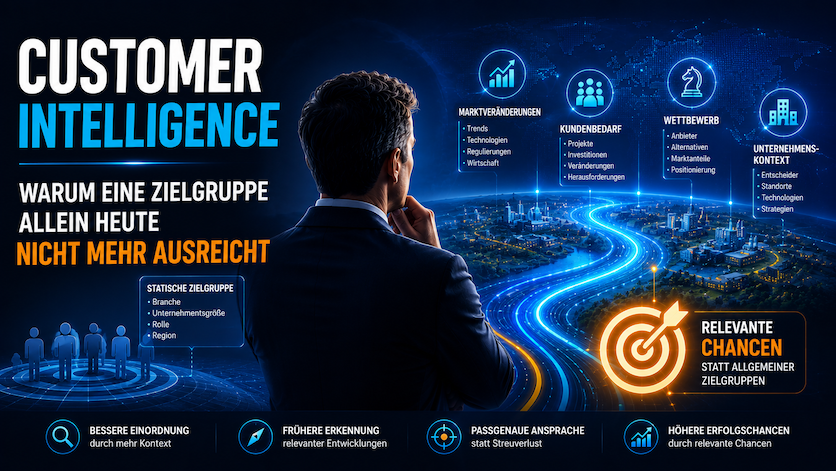
A traditional target market is often defined by industry. The Commercial Space, on the other hand, emerges from the question of which companies might have the relevant products, processes, technologies, and business situations.
This can reveal companies that might never have been considered in a traditional market segmentation.
A manufacturer of specialized materials might find that its solution is relevant wherever specific thermal, chemical, or mechanical requirements arise. These requirements can span multiple industries and may have little to do with any single industry classification.
The Commercial Space therefore does not simply describe a list of potential customers. It maps out the space in which relevant needs can fundamentally arise.
This creates an important distinction between market potential and current opportunity. A company can be part of our Commercial Space without being of interest to sales today. Its products and processes may be an excellent fit for our own offerings, but there is currently no apparent reason for change.
Commercial Intelligence continues to monitor this account nonetheless.
After all, a fundamentally suitable company can become a relevant opportunity at any time due to a change.
Now the actual market monitoring begins
This marks a departure from the traditional notion of a one-time target customer analysis.
The Commercial Space is not a static directory that is created once and then processed. It is a dynamic market in which companies are constantly changing.
Products are refined, production capacities expanded, technologies introduced, and locations changed. At the same time, new regulatory requirements, competitive pressures, or difficulties in existing supply chains arise. Many of these developments leave publicly visible traces long before they result in a formal inquiry.
The Commercial Intelligence process monitors precisely these changes.
This is where the various information perspectives we’ve developed in previous posts come together. Market Intelligence provides the overarching economic and technological context. Customer Intelligence helps us understand which companies are fundamentally a good fit. Demand Intelligence focuses on changes that could give rise to demand. Competitive Intelligence reveals which alternatives and competitive dynamics influence a decision, while Account Intelligence focuses on the individual account—its specific situation, technologies, and relevant individuals.
These perspectives do not exist side by side as separate reports.
They become valuable when they are integrated.
Company analysis lays the foundation for interpretation
Observing a market initially generates information above all else.
One company opens a new location. Another is looking for additional production staff. A third introduces a new generation of products. At the same time, new technologies appear in job postings or investments are announced.
None of this information, on its own, constitutes commercial intelligence.
The crucial step is to understand its significance in the context of the Need Profile.
For example, when a company expands its production space, it must first be clarified what this space is intended for. For an automation provider, a new warehouse may have a different significance than the establishment of an additional manufacturing facility. Even a job posting can be interpreted differently, depending on whether it describes a need for a replacement or indicates the development of new skills.
That is why Commercial Intelligence does not rely solely on established facts. It combines observation with interpretation while clearly distinguishing between the two.
The statement that a company is building a new facility may be confirmed by a source. The assumption, however, that this could result in additional automation needs is a hypothesis.
This distinction is central to the entire process.
Commercial Intelligence should not pretend to know more than is actually known. It should reduce uncertainty to the extent that a better decision can result.
Information Becomes Opportunity Signals
A signal arises when a detected change takes on potential commercial significance in the context of one’s own offering.
This also means that the same information can be relevant in completely different ways for different providers.
The expansion of a production facility might be of interest to a machine manufacturer, but for a logistics provider, it would only be relevant if it simultaneously generates additional flows of goods. A new product line can become significant for a materials manufacturer if it leads to changes in technical requirements, whereas it may have no significance whatsoever for a software provider.
Commercial Intelligence therefore never evaluates information in isolation.
The connection to the Need Profile determines whether a piece of news becomes an opportunity signal.
This becomes particularly relevant when multiple signals point to a common trend. Rising production volumes, ongoing recruitment efforts, and the development of additional automation expertise can together generate a much stronger hypothesis about demand than any single signal on its own.
At this point, we move beyond mere information gathering.
We begin to recognize a potential business narrative.
Opportunity Intelligence emerges from the integration of information
This is precisely where the role of Opportunity Intelligence lies.
It is not simply another data component alongside the other information disciplines. Rather, it arises from their interplay.
We know the market and the broader trends. We understand why a company is fundamentally a good fit for our offering. We recognize changes that could trigger a need. We know something about the competitive landscape and increasingly have account-specific context.
This information gives rise to a new question:
How relevant is this situation to a specific sales decision?
Opportunity Intelligence seeks to answer this question in a transparent way.
The goal is not to generate a supposedly exact probability of purchase. A percentage alone would be of little help. What matters far more is whether we can explain why one company deserves more attention right now than another.
Good Opportunity Intelligence therefore provides a well-reasoned hypothesis. It shows what changes have been observed, how these changes relate to the company’s own need profile, and what open questions still need to be answered.
This transforms company information into a basis for decision-making.
Prioritization Replaces Working Through Lists
The next step in the commercial intelligence process is therefore not to immediately hand over every interesting company to the sales team.
First, we must prioritize.
Some accounts are an excellent fit but show little change at the moment. Others are clearly in flux but are only a limited fit for your own offering. Still others combine a strong fit with current opportunity signals and a trend where a conversation might make sense right now.
These differences are crucial.
The commercial intelligence process therefore aims to direct available sales time toward those accounts where business fit, the hypothesis of need, and timing align effectively.
This changes the significance of lead qualification. In the past, it often didn’t begin until after the initial contact. The sales team would call a lead and try to determine during the conversation whether there was any need at all.
Commercial Intelligence shifts part of this qualification to before the conversation.
Not to make the conversation unnecessary, but to ensure that the sales team speaks more frequently with companies where there is already a clear reason for the conversation.
Marketing and sales target different stages of readiness
Prioritization also determines which next step makes sense.
Not every relevant company should be approached immediately by sales.
An account may fit the need profile very well and show initial signs of change, but still be far from a concrete decision. At this stage, marketing may be more effective than a direct sales approach. Content can address relevant issues and build awareness while the company continues to be monitored.
For another account, the signals are already so strong that a direct conversation seems appropriate. Perhaps a site expansion is underway, new positions are being filled, and technical requirements are visibly changing.
Now the focus shifts to sales.
This is precisely why marketing and sales share the same data foundation in the Commercial Intelligence model. Both focus on the same account but use the information to make different decisions.
Marketing asks how interest and understanding can be built.
Sales decides when this situation should lead to a face-to-face meeting.
The handoff thus no longer occurs solely based on a form or a lead score, but rather on the account’s overall commercial situation.
The sales process begins with context
As soon as an account is prioritized for direct outreach, Commercial Intelligence enters the actual sales process.
But here, too, something is changing.
The sales representative doesn’t just receive a company name and an email address. They receive the context that led to the prioritization. They know what changes have been observed, what demand hypothesis emerged from them, and what information is still missing.
This allows the conversation to begin on a different level.
Instead of starting with a product presentation, the salesperson can test a hypothesis.
Perhaps the real question isn’t: “Are you interested in automation?”
But rather: “You’re currently expanding your production and, at the same time, looking for additional assembly staff. Does this already raise the question for you of which processes can still be scaled manually in the future?”
The research thus does not serve as a pretext for a sales pitch.
It provides a better question.
And that’s exactly where commercial intelligence transitions into traditional sales work.
The hypothesis becomes a confirmed opportunity
Only the customer conversation can answer many of the open questions that weren’t visible from the outside.
Perhaps the suspected need is confirmed. Perhaps it turns out that the situation is entirely different. It’s possible that a project already exists or that the issue won’t become relevant for another year. Existing suppliers, internal priorities, or budgets also often only become apparent through direct communication.
This step is crucial because a commercial opportunity can now become an actual sales opportunity.
Commercial intelligence therefore does not end when a lead is handed over to the sales team.
The insights gained from the conversation must be fed back into the system.
If the hypothesis was confirmed, the underlying pattern gains greater significance. If it was incorrect, that, too, is valuable. Perhaps a signal was overestimated or a specific business situation was misinterpreted.
This creates a learning process.
Closing the deal is therefore not the end
In many sales models, a process ends with “Won” or “Lost.”
For Commercial Intelligence, an additional learning phase begins at this point.
If an opportunity was won, it’s worth asking which signals were visible early on. What changes preceded the project? Why did the company become relevant? When did the first contact take place, and what information actually proved helpful?
Lost opportunities yield different insights. Perhaps the fit was good, but the timing was off. Perhaps a competitor was identified too late, or the supposed signal of need actually had a completely different cause.
This feedback improves future need profiles and evaluation criteria.
With every successful or unsuccessful project, the company can better understand which patterns are actually commercially relevant.
As a result, commercial intelligence becomes more than just a process of market observation.
It becomes an organizational learning cycle.
The process forms a closed loop
This makes it clear why Commercial Intelligence is more than just another research tool.
The process begins with an understanding of the company’s own offering and the situations in which it generates value for customers. From this, a need profile is developed, followed by the commercial space, within which relevant companies are continuously monitored.
New information is not simply collected but evaluated within its context. Relevant changes give rise to opportunity signals, the interplay of which is interpreted through Opportunity Intelligence. Accounts are then prioritized and, depending on their maturity, either supported by marketing or approached by sales.
During customer discussions, the hypotheses formed earlier are tested. If the situation is confirmed, a classic sales opportunity arises, which is then guided through the existing sales process until it is closed.
The results of this process are then fed back into the system.
This closes the loop.
Market observation gives rise to hypotheses; hypotheses lead to conversations; and conversations yield new insights about the market.
Commercial Intelligence thus bridges two worlds
This is perhaps the greatest strength of this approach.
Today, companies possess, on the one hand, a great deal of information about existing customers and ongoing sales processes. This information is primarily stored in CRM systems and is generated through day-to-day sales activities.
On the other hand, outside these systems lies a vast pool of information about companies, markets, and changes.
Commercial Intelligence bridges these two worlds.
It monitors what is happening outside the existing pipeline while simultaneously leveraging insights from real-world sales processes to continually improve this monitoring.
This creates a new layer between the market and CRM.
It determines which companies in the market deserve attention in the first place and when they should be moved into an active commercial process.
It is precisely this level that was missing in many traditional sales systems.
Conclusion
Commercial intelligence only becomes truly valuable when individual analyses are woven into a seamless process.
This process does not begin with a list of leads, but with an understanding of the conditions under which a company’s offering becomes relevant. Based on this, it defines a commercial space, continuously monitors companies, and interprets changes in the context of the need profile.
Relevant developments give rise to opportunity signals. Opportunity Intelligence links these signals to market, customer, competitive, and account context, thereby helping to determine which companies deserve special attention.
Marketing and sales engage these accounts based on their current maturity. Hypotheses are tested through direct conversations, and potential commercial opportunities are transformed into confirmed sales opportunities. The results of these conversations and sales processes are then fed back into the system to improve it.
This creates a closed loop of market understanding, observation, interpretation, decision-making, sales action, and learning.
And this is precisely what transforms Commercial Intelligence from a concept into an operational system.
The next question, therefore, is no longer how the process works.
It is:
Who takes on which task, what systems are needed, and how do you permanently embed this process within an organization?
In the next post: The Commercial Intelligence Operating Model
A good process alone is not enough.
As soon as commercial intelligence is to be operated on an ongoing basis, organizational questions arise. Who maintains the Need Profile? Who decides which Opportunity Signals are relevant? Which tasks fall under Marketing, which under Sales, and which might fall under a central Commercial Intelligence function? And how do AI, CRM, marketing automation, and human expertise work together in this process?
This turns the methodology into an organizational issue.
That’s exactly what the next article is about:
CI-034: The Commercial Intelligence Operating Model.
After all, Commercial Intelligence only becomes a sustainable capability for the company when it’s not just defined what needs to be done, but also who does it and how.
👉 Recommendation
In addition to manual research, we’ve developed automated tools for you:
bloo.research— Find the right B2B companies in minutes
bloo.radar - Find out what your competition is going to do next
before they do it.
🚀 Next Step
If you want to not only understand AI but also implement it in a structured way within your company, then:
👉 Learn more about our AI training:
https://bloo.school
👉 Learn more about our Smart Market Fit offerings:
https://bloola.com/smf - The Smart Market Fit Course
https://bloola.com/smf-system - The Smart Market Fit System for Businesses
👉 Or learn more about our consulting and automation solutions:
https://bloola.com
Share this
You May Also Like
These Related Stories

The New Sales KPI (CI-032)

Opportunity Intelligence - Why Demand Alone Does Not Equate to a Business Opportunity (CI-014)