The reason for this is relatively simple.
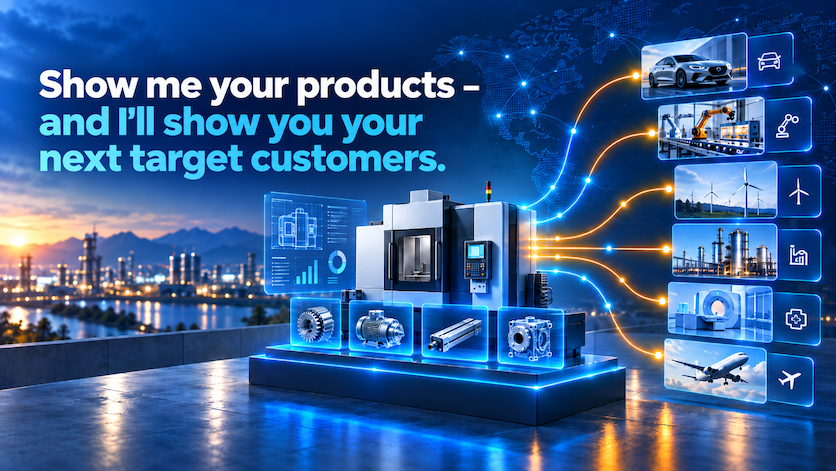
Companies don’t buy technical products and solutions based on their industry code. They buy them because tasks, problems, or requirements arise within their processes.
A manufacturer of clamping technology needs companies that machine workpieces and must position them reliably for that purpose.
A supplier of welding robots is interested in production processes where recurring welding tasks can be automated.
A manufacturer of industrial burner systems seeks companies where heat is an integral part of the production process.
A supplier of dosing technology is interested in processes where adhesives, liquids, or other media must be precisely dosed.
And a supplier of tool monitoring systems needs companies where tool condition, tool breakage, or process reliability play a role in machining.
The need, therefore, does not arise from the industry itself.
It arises from the process itself.
A manufacturing process alone does not necessarily mean that a company will make a purchase. But it answers a much more important underlying question:
Can the problem that our product solves even arise in this company?
And that is precisely a significant difference.
A target audience profile becomes a need profile
Let’s stick with our tool monitoring provider.
The classic profile might look like this:
Mechanical engineering, Germany, 50 to 500 employees.
A needs profile would go much deeper.
For example, companies with their own CNC machining operations that use multiple machining centers, produce complex workpieces, machine challenging materials, or are increasingly automating their production would be of interest.
It becomes even more interesting when additional information is added.
Perhaps the company operates unmanned shifts.
Perhaps it is currently investing in additional machining centers.
Perhaps it is looking for CNC specialists.
Perhaps it’s announcing an expansion of its production capacity.
Now we’re no longer just describing what a potential customer looks like statistically.
We’re describing what operational conditions must be in place for our offer to be relevant at all.
This also changes the way we search for customers.
We’re no longer looking for companies that fall into the same category.
We’re looking for companies where certain processes take place.
The key point: Manufacturing processes leave traces
A few years ago, conducting such research on a large scale would have been hardly economical.
A sales representative would have had to search through company website after company website. They would have had to read product catalogs, analyze references, review job postings, and look for clues about machinery or production processes.
That’s feasible for ten companies.
But not with a thousand companies.
Today, AI is fundamentally changing this situation.
That’s because manufacturing processes often leave digital traces.
Company websites mention 5-axis milling, injection molding, extrusion, laser cutting, stamping, coating, welding, heat treatment, or automated assembly.
Product pages show components and materials.
Technical brochures list machines or systems.
Reference projects provide insights into production requirements.
Job postings seek CNC millers, process mechanics, welding specialists, or PLC programmers.
Press releases report on new machines, production facilities, or manufacturing lines.
A single piece of information does not provide certainty.
But multiple clues begin to paint a picture.
And that is precisely where the true strength of modern customer research lies.
It no longer relies solely on data fields.
It works with evidence.
Why a job posting sometimes reveals more than the industry code
Let’s imagine a company that is listed in a database simply as a manufacturer of technical plastic products.
For a provider of automation technology, this information initially reveals relatively little.
Then the company posts several job listings.
They’re looking for a process engineer specializing in plastics technology, a PLC programmer, a maintenance technician for automated production systems, and an injection molding production manager.
Suddenly, we know a lot more.
We can assume with a high degree of certainty that injection molding constitutes a significant portion of production. We see indications of automated systems. And we see that corresponding technical personnel are needed.
The job postings do not yet prove a specific purchasing need.
But they bring us much closer to the actual production reality than the information “plastics industry.”
This is a key concept in commercial intelligence:
It’s not the individual data point that matters.
What matters is the context in which different pieces of information are situated.
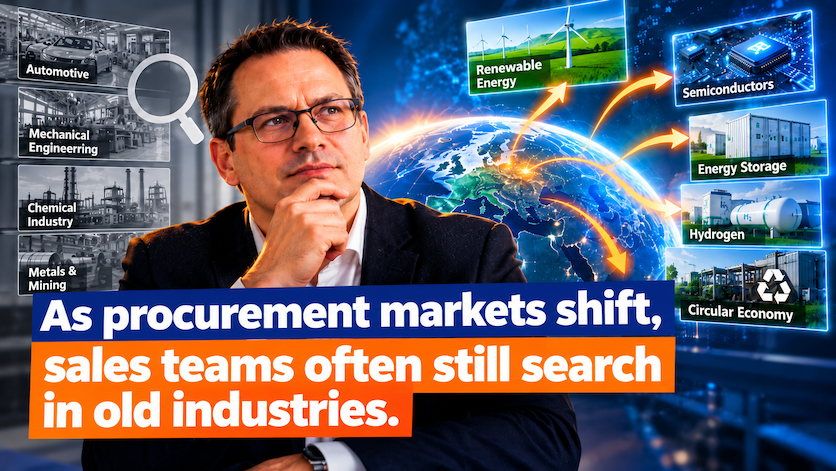
Your real market may be much larger than your industry
The search for manufacturing processes has a second implication that may be even more important strategically.
If companies define their markets exclusively by industry, they may not only target the wrong companies.
They may also overlook very good customers.
Let’s take a provider of industrial laser technology as an example.
Its solution may be relevant to an automotive supplier. But it’s just as relevant to a machine builder, a manufacturer of household appliances, a medical technology producer, an electronics manufacturer, or a specialized contract manufacturer.
These companies may be classified in completely different industries.
What connects them is not a shared classification.
What connects them is a process.
This changes our understanding of a market.
A company’s relevant market does not necessarily consist of a specific industry.
It can consist of all companies that face the same task, technology, or production requirement.
This is precisely what creates a commercial space.
A search space that is not guided solely by who a company is, but by what happens there.
But a suitable manufacturing process is not yet a signal to buy
At this point, we need to draw an important line.
If we discover that a company operates five modern 5-axis machining centers, it can be highly interesting for a supplier of tools, clamping technology, coolants, automation, or tool monitoring.
But that doesn’t necessarily mean this company is looking to buy right now.
Perhaps its machine park is fully equipped.
Perhaps it has a long-standing supplier contract.
Perhaps there is currently no approval for investment.
Perhaps the problem we’re solving simply isn’t a priority for them.
The manufacturing process therefore initially increases a company’s technical relevance.
It tells us:
A need may arise here.
To turn this into a real opportunity, we need more information.
Is the company investing?
Is it expanding its capacity?
Is it purchasing new machinery?
Is it modifying its products?
Is it automating its manufacturing?
Is it looking to hire additional employees?
Are there quality or capacity issues?
Only when such information is added does customer intelligence begin to transform into true demand intelligence.
Industries remain important. But they are only the beginning.
The conclusion, therefore, is not that we should do away with SIC, NACE, or WZ codes.
They continue to serve an important purpose.
They help structure markets and establish an initial search scope.
We just shouldn’t confuse them with actual demand.
The statement
“This company is in the mechanical engineering sector”
is significantly less valuable to the sales team than:
“This company operates its own 5-axis CNC manufacturing facility, machines complex aluminum and titanium components, and is currently expanding its production capacity.”
Both pieces of information may be correct.
But only the second one begins to explain why this company might be of interest to us.
That is precisely the difference between a target audience list and commercial intelligence.
Need vs. Industry
Perhaps that’s why the crucial shift isn’t actually:
industry or manufacturing process?
The real shift is:
Category or context?
The industry tells us where a company is classified economically.
The manufacturing process shows us how production takes place there.
The technologies used show us what is being worked with.
And changes can later show us why new demand is emerging right now.
The more of this information we gather, the less we have to guess in sales.
We begin to understand.
Conclusion
Perhaps, then, the next time we define a target market, we shouldn’t start by asking:
“Which industries buy our product?”
But rather:
“In which processes does the problem that our product solves actually arise?”
This small shift in the question can completely transform a market.
Because suddenly, we’re no longer just looking for companies that appear statistically similar.
We’re looking for companies that are relevant for the same business reason.
And in doing so, a company from a seemingly unrelated industry can be more valuable than a hundred companies from our previous core target group.
In the next post
Manufacturing processes show us how a company produces its goods.
But even that is only part of the story.
After all, sometimes we don’t even need to look inside the production facility first to understand what materials, components, technologies, or services a company might need.
It’s enough to look at what that company sells itself.
A product portfolio contains a surprising number of clues about what a company needs to purchase, process, or incorporate into its own products.
That’s exactly what the next post is about:
Products Reveal Their Suppliers
How to identify new target customers from product portfolios.
If you want to not only understand AI but also implement it systematically in your company, then: