Real-World Examples and a Conceptual Model
When a company issues a request for proposals or actively seeks a supplier, its need becomes visible to the market. To the sales team, this initially seems like the ideal time to approach the company; in reality, however, the opportunity is often already well advanced at this stage. Requirements have been discussed internally, budgets prepared, technical alternatives evaluated, and initial discussions with existing partners may have already taken place. Commercial intelligence therefore aims to get involved much earlier. The goal is not to predict projects, but to identify changes that could later give rise to projects.
The key shift in perspective lies not in searching for published needs, but in identifying companies whose existing ways of working are coming under pressure due to a new situation. For example, a manufacturing company may operate using the same processes for years until rising order volumes, a new product generation, or difficulties in recruiting staff cause these processes to no longer scale adequately. At this point, an investment decision may not yet have been made, yet the economic landscape is already shifting. It is precisely in this gap between the current state and the new requirements that future opportunities begin to emerge.
Projects Arise from Change
Let’s imagine a medium-sized manufacturer with its own assembly line. The company wins a major order and must significantly increase its production volume. At the same time, it is struggling to find additional assembly workers, while a new product line is expected to generate further production volumes. No one has yet put an automation solution out to bid, and there may not even be a concrete automation project in the works internally. Nevertheless, a clear connection emerges: If the company wants to grow without being able to build up the necessary manual capacity, it will sooner or later have to reevaluate its production methods.
For an automation provider, this is precisely the kind of situation that presents an opportunity. The provider does not yet know whether an investment will actually be made, but already has a well-founded hypothesis regarding the need. The sales question is therefore not “Do you need automation?” but, for example, how the company plans to achieve its projected production volumes given the challenging staffing situation. The difference is significant, because the salesperson does not begin the conversation with their product, but with a development that is actually taking place at the customer’s site.
The same principle applies in other markets as well. A supplier of specialized materials might recognize that a plant manufacturer is developing a new generation of products involving higher temperatures or more aggressive media. Purchasing may not yet be looking for a new materials supplier, but the changed technical requirements could mean that existing materials are no longer sufficient. Similarly, a logistics service provider can become an attractive option early on if a manufacturer is entering new markets outside the EU, thereby creating additional customs and transportation requirements. In both cases, the need does not become apparent through a request for proposals, but rather through the consequences of a change within the company.
From Change to a Hypothesis of Need
A simple conceptual model can be derived from this. It begins with an observable change—such as growth, a new product generation, a new location, or a shift in technological focus. However, the actual commercial intelligence work only begins with the question of what operational consequences result from this. Growth may require additional capacity, a new product generation may necessitate different materials or processes, and a new market may alter existing supply or logistics models.
Only when this consequence aligns with the company’s own need profile does a relevant demand hypothesis emerge. The key line of reasoning is therefore not “The company is growing, so it will buy,” but rather: The company is growing, which changes a specific process; this change may create a problem, and it is precisely this problem that falls within the scope of our offering. The quality of the analysis stems from these intermediate steps, because they prevent every corporate signal from being hastily interpreted as a buying signal.
Commercial Intelligence therefore fundamentally works with hypotheses rather than with supposed certainty. A new facility may indicate an expansion of production, but it doesn’t have to. A job posting may suggest the development of new skills, but it could simply be a replacement hire. Only when multiple pieces of information support the same trend does the hypothesis become more robust.
Multiple signals tell a story
This is precisely why multiple smaller signals are often more valuable than a single major announcement. When a company launches a new product family, expands its production facilities at the same time, and is also seeking process or automation engineers, a connection emerges that reveals far more than any piece of information on its own. The individual signals begin to tell a story: The company is changing its value creation and may be preparing for a new production reality.
The chronological sequence also plays an important role in this interpretation. A new major order may initially serve as the economic trigger. Subsequently, the company might attempt to build up additional staff, later expand its production space, and finally intensify its search for technical or automation-related expertise. Although no job posting exists yet, the development becomes more concrete with every step.
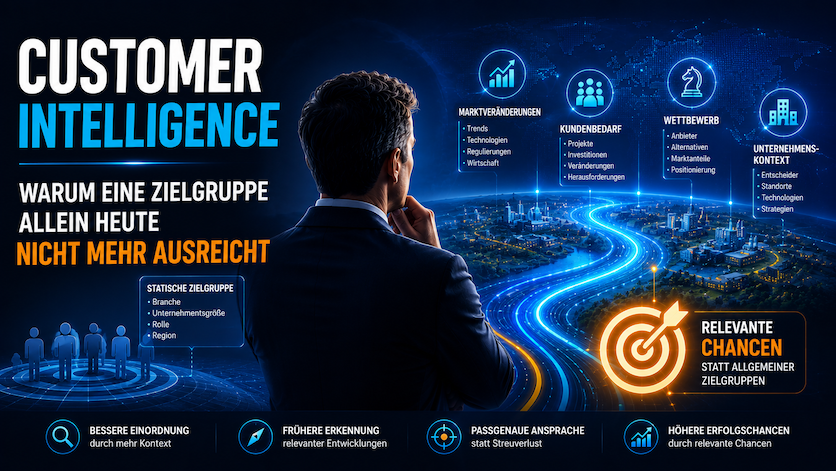
It is precisely this temporal perspective that distinguishes Commercial Intelligence from static company research. We look not only at a company’s current characteristics but also at how it is changing. AI can help monitor such developments across many companies and consolidate information that a single sales representative could hardly track on an ongoing basis. However, the commercial interpretation remains a task in which expertise and context are crucial.
The most interesting phase begins before buying intent
The period before a company actively begins searching for a solution is particularly exciting. Traditional intent data often only becomes visible once employees are already researching specific topics, consuming content, or comparing providers. However, the business need may have existed for much longer by that point. A production manager may not actively begin searching for automation solutions until it has long since become clear internally that increasing production volumes can no longer be reliably achieved with the existing staffing model.
Commercial Intelligence therefore seeks to identify the underlying business situation earlier. Uncertainty is inevitably greater in this phase, but that is precisely where the strategic advantage lies. Those who enter the picture only after requirements have been fully defined must position themselves within an already established project. Those who recognize the trend earlier, on the other hand, can initiate a conversation while the customer is still working to understand their problem more precisely and evaluate potential solutions.
Early detection does not, however, mean immediately approaching every account from a sales perspective. Some developments should be monitored further for the time being, while in other cases, marketing can provide support with relevant content. The main advantage lies in gaining time and being able to make a deliberate decision about when personal contact truly makes sense.
The Lead Becomes an Emerging Opportunity
This also changes our understanding of what an opportunity actually is. There is an important intermediate stage between a fundamentally suitable company and a confirmed sales opportunity. An account may fit the need profile very well and show several relevant changes, even though there is no project name, no budget, and no official intent to purchase yet.
We can understandthis state as an “emerging opportunity.”
An “emerging opportunity” describes a company where a commercially interesting situation is developing, but whose actual significance has not yet been confirmed by the customer. For sales, this phase is particularly valuable because it allows them to decide whether additional research, monitoring, marketing activities, or even an in-person meeting is warranted.
Commercial intelligence, therefore, is not tasked with securing an order at an early stage. Its purpose is to narrow down a large market to those companies where a closer look today offers particular value. As a result, in-depth human research focuses on significantly fewer accounts and is deployed precisely where it has the highest probability of yielding relevant insights.
Conclusion
Identifying companies before projects officially come to light does not mean knowing the future. It means understanding changes and their potential business implications earlier.
Projects rarely emerge out of the blue. Growth, new products, technological changes, capacity constraints, or new market demands initially alter a company’s situation. This leads to operational consequences, and only then can a concrete need arise. Commercial Intelligence seeks to recognize this development early enough to formulate a robust hypothesis regarding the need.
The crucial sales question is therefore no longer just:
“Which company currently has a visible project?”
But rather:
“At which company are the conditions currently emerging that could lead to a future project?”
That is precisely where the competitive edge lies—not in responding more quickly to a request for proposal, but in understanding earlier why a request for proposal might arise in the first place.
In the next post: From Opportunity Signal to Contract
In the next step, we’ll therefore track such an emerging opportunity through the entire commercial intelligence process. We’ll start with an early signal, combine additional information to form a hypothesis about the need, and then examine how this can lead to prioritization, a meaningful conversation starter, and ultimately a confirmed sales opportunity.
CI-036: From Opportunity Signal to Order illustrates the complete process using a concrete industry example and thus answers the crucial question: How does early insight actually turn into business?
bloo.research— Find the right B2B companies in minutes
bloo.radar - Find out what your competition is going to do next
before they do it.
🚀 Next Step
If you want to not only understand AI but also implement it in a structured way within your company, then:
👉 Learn more about our AI training:
https://bloo.school
👉 Learn more about our Smart Market Fit offerings:
https://bloola.com/smf - The Smart Market Fit Course
https://bloola.com/smf-system - The Smart Market Fit System for Businesses
👉 Or learn more about our consulting and automation solutions:
https://bloola.com