How the Role of Sales Is Changing (CI-030)

As research, prioritization, and preparation are increasingly supported by AI
When artificial intelligence can analyze companies, monitor market changes, and identify potential needs earlier, this inevitably changes the nature of sales work as well. The focus here is less on the frequently asked question of whether AI will replace salespeople. What’s far more interesting is determining which tasks should still be meaningfully performed by humans in the future and where technology can create better conditions for successful sales work.
For many years, a significant part of acquiring new customers involved simply figuring out who might be worth talking to. Sales representatives searched for companies, reviewed websites, identified contacts, read industry news, and tried to deduce a potential reason for a conversation from the limited information available. Only then did what we actually consider sales begin: approaching a company, understanding its situation, and working together to determine whether a partnership might make sense.
Commercial Intelligence shifts this boundary. When systems can handle a large part of the preliminary research and highlight which companies are a good fit in terms of expertise, what changes are currently taking place, and why this might create a potential need, the salesperson begins their work at a different point. They no longer have to start with a long list of unknown companies. They can begin where a well-founded connection between the customer, the situation, and their own offering is already apparent.
This doesn’t mean sales is disappearing. Rather, its true role becomes much clearer.
For a long time, salespeople were both researchers and sellers
In B2B sales in particular, this dual role has become the norm. A good sales representative is expected to know their market, identify relevant companies, research contacts, understand their situation, and then conduct a substantive conversation. What looks like a single task on paper actually consists of very different activities.
Researching new accounts requires patience, a methodical approach, and the ability to sift through large amounts of information. A good customer conversation, on the other hand, requires empathy, subject matter expertise, sound judgment, and the ability to work through uncertainty together with the customer. Combining these two aspects was long necessary because there were hardly any other options.
However, this creates a structural problem. The more time a sales representative invests in the search, the less time remains for conversations. If, on the other hand, research and preparation are cut back, the risk of approaching companies without sufficient context increases. Many sales teams today resolve this conflict by working with large lists, standardized sequences, and high contact volumes. The necessary efficiency is then achieved by scaling up the outreach.
AI opens up a different path. It can scale part of the research work without automatically having to automate the customer conversation as well. This allows both tasks to be more clearly separated from one another for the first time.
The salesperson no longer starts with a blank search field
Let’s imagine a sales representative at a provider of industrial automation. Today, their work with new customers might begin with a database, an industry list, or a Google search. They find manufacturing companies, open websites, and try to figure out which ones might be interested in their solution.
In a commercial intelligence model, the starting point can look different. The system knows the company’s need profile and thus understands which production scenarios are fundamentally relevant. It monitors suitable companies and recognizes, for example, that a manufacturer is expanding its capacity while simultaneously facing difficulties in recruiting staff and is also posting job openings in the field of automation.
As a result, the sales representative doesn’t just receive a company name. They receive a potential business opportunity and the sources from which this assessment was derived.
Their first task is no longer to somehow filter out interesting companies from a large list. They must assess whether the identified situation is truly relevant, what questions remain unanswered, and whether a meeting would be worthwhile.
This shift is significant because it transforms the salesperson from an information gatherer into a decision-maker.
In the future, effective sales work will begin with a hypothesis
Commercial Intelligence also changes how an initial contact is prepared. Traditional cold calling often begins with relatively little information. The salesperson knows the industry, the company’s size, and perhaps the role of the person they’re speaking with. During the conversation, they must first determine whether there’s even a relevant topic to discuss.
If a hypothesis about the customer’s needs has already been formed before the conversation, this initial approach changes.
For example, a salesperson at an automation provider might know that a company is expanding its production and, at the same time, has been looking for additional production staff for some time. This alone does not necessarily mean that an investment in automation is imminent. However, a plausible question arises: Is this growth causing certain manual production steps to increasingly become a bottleneck?
This is a much better way to start the conversation than claiming to have the perfect automation solution.
The difference is that the research isn’t meant to provide a ready-made answer. It’s meant to lay the groundwork for an informed hypothesis that the sales team can test together with the customer.
This also changes the quality of the sales pitch. Personalization no longer means simply inserting the company name or a recently published news item into an email. True personalization occurs when the salesperson can demonstrate that they have familiarized themselves with the company’s situation and ask a question that is actually relevant to that situation.
Listening Becomes More Important, Not Less
At first glance, one might assume that more extensive company information would lead to sales conversations becoming more data-driven and less human. In fact, the exact opposite should happen.
The more a salesperson thinks they know before the conversation, the more important it becomes to avoid confusing that information with the customer’s reality. A job posting may indicate a staffing shortage, but it doesn’t necessarily prove it. An expansion of a location may create new capacity without automatically generating a need for the salesperson’s own offering.
Commercial intelligence therefore provides hypotheses and context, not definitive truths.
The salesperson must still find out how the customer perceives their own situation. Perhaps the problem is different than expected. Perhaps the change has an internal significance that wasn’t apparent from the outside. Perhaps a solution already exists, or the issue isn’t a priority right now.
This is precisely why good listening becomes more important. The salesperson enters the conversation better prepared, but must not confuse this preparation with certainty.
In the future, the quality of sales will not stem from knowing as much data as possible about a customer. It will stem from the ability to use that information to ask better questions.
Expert knowledge is gaining ground over product knowledge
This also changes the type of knowledge that becomes particularly valuable in sales.
In many organizations, sales has traditionally been built heavily on product knowledge. Employees must know the features, variants, prices, and technical specifications of their solutions. This knowledge remains necessary, but it is increasingly insufficient.
As AI can provide information about customers more quickly and customers themselves can access product information with increasing ease, differentiation is increasingly driven by contextual knowledge. A good salesperson must understand which business and technical situations lead to a need, what impact changes have on a customer’s operations, and what alternatives exist to a given investment.
A provider of tool monitoring should therefore not only be able to explain how its system works. Its sales team must understand when tool wear becomes economically critical, what role process reliability plays in automated shifts, and why increasing machine utilization changes the significance of downtime.
Only this knowledge makes it possible to interpret the signals identified by commercial intelligence in a meaningful way.
AI does not, therefore, render expert knowledge obsolete. It amplifies its impact. The technology can identify situations, but the sales team must understand why these situations are relevant.
From Activity to Prioritization
Another shift concerns the management of the sales force. Many organizations measure activity because activity is easy to measure. The number of calls, emails, appointments, and processed leads can be clearly tracked and compared.
These metrics do not automatically lose their significance. However, they say little about whether the activities were directed at the right companies.
When Commercial Intelligence can better distinguish which accounts are currently relevant, the quality of prioritization becomes an increasingly important sales metric. A sales representative who focuses on twenty well-selected companies and generates several relevant conversations from them can be significantly more productive than someone who reaches out to a hundred contacts from a general database.
This also shifts the focus of sales management. It is no longer just a matter of whether there is enough activity, but whether available sales time is concentrated on those situations where there is a meaningful reason for a conversation.
This is particularly relevant in industrial B2B sales, because individual conversations require significant preparation and decision-making processes can be lengthy. In this context, it makes little economic sense to pursue large numbers of poorly qualified companies with the same intensity as a few accounts with a clearly defined need.
Sales Becomes an Interpreter of Commercial Signals
This shift gives rise to a new core competency.
The salesperson must learn to interpret signals.
Expanding to a new location may be interesting, but it doesn’t have to be. A job posting may indicate an emerging need or simply represent a replacement hire. A new product may trigger changes in production and the supply chain, while another can be manufactured without issue using existing resources.
The system can find and connect such information. People must assess which narrative actually makes sense based on this information.
This requires a different way of thinking than traditional lead generation. Salespeople are increasingly working with probabilities and hypotheses. They must be able to distinguish between certain knowledge, reasonable assumptions, and open questions.
This is precisely where the parallel to good consulting lies. There, too, the task is not to immediately present a ready-made solution. First, one must understand what the actual situation is.
Modern sales is thus moving more toward an analytical and consultative role.
Relationships remain the one aspect that data cannot replace
The more research and analysis are automated, the more apparent it becomes what technology simply cannot take over.
A complex B2B purchase is rarely just a rational decision based on technical specifications. Within the customer’s company, there are differing interests, risks, and priorities. Production management evaluates an investment differently than procurement, IT, or executive management. Often, multiple people need to be convinced, and not every uncertainty can be resolved through data or product information.
Sales therefore continues to be about building trust, understanding different perspectives, and working with the customer to develop a viable path forward.
Commercial intelligence can help identify the right timing and a relevant opportunity for engagement. However, it cannot guarantee that the customer will trust the provider or that consensus will be reached within the buying center.
Especially as products and information become easier to compare, this human element may even gain in importance.
The salesperson of the future is therefore no less important. Their most valuable activities are simply shifting away from tasks that machines can scale more effectively, toward tasks where human understanding and judgment make all the difference.
This also changes the demands placed on sales teams
In the long term, this development will have an impact on how sales organizations are structured and how employees are developed.
When a large portion of the research is prepared automatically, simple list-based work loses its importance. At the same time, analytical thinking, industry knowledge, and the ability to quickly assess complex situations become more important.
The onboarding of new employees may also change. Today, it often takes them years to build sufficient market knowledge and intuitively recognize typical customer situations. If commercial intelligence makes part of this knowledge available in a structured way, new employees can more quickly understand why certain accounts are of interest and what signals experienced colleagues would recognize there.
This does not replace the experiential knowledge of good salespeople. Rather, it allows that knowledge to flow back into the organization more systematically for the first time. If an experienced employee knows that a certain combination of capacity expansion, staff shortages, and new quality requirements often leads to investments, this experience can be incorporated into need profiles and search logic.
In this way, individual sales knowledge gradually becomes organizational knowledge.
The salesperson becomes a Commercial Intelligence User
Ultimately, this may give rise to a new vision of what a modern sales work environment should be capable of.
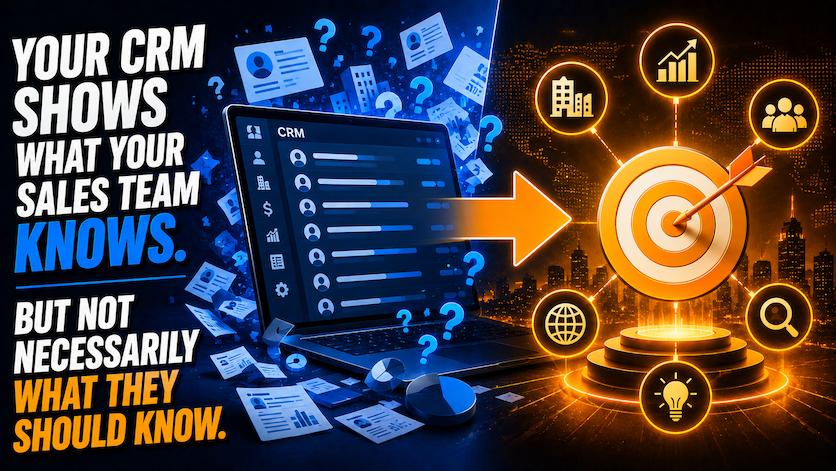
The salesperson no longer works solely in a CRM where contacts, tasks, and opportunities are documented. They also need a view of the market that shows which companies are changing, which opportunity signals are emerging, and why certain accounts deserve attention right now.
The CRM continues to answer the question of what is happening with known customers and opportunities.
Commercial Intelligence expands this perspective to include the question of what is currently emerging outside the existing pipeline.
Sales representatives thus navigate between both worlds. They use Commercial Intelligence to identify opportunities earlier and the CRM to develop relationships and concrete sales processes from them.
This makes the role broader, but also clearer. The sales team shouldn’t aim to collect as much data as possible. Instead, they should use the right information to enable better decisions and more effective conversations.
Conclusion
The role of sales is not changing because AI can suddenly sell. It is changing because AI can take over part of the work that was previously necessary before good sales could even begin.
Companies can research faster, continuously monitor developments, and identify potential needs earlier. As a result, sales representatives spend less time gathering information and can focus more on understanding its significance.
The salesperson evolves from a researcher into a decision-maker. Research gives rise to a hypothesis that is tested during the customer conversation. Expertise, judgment, and relationship-building skills become increasingly important, because that is precisely where the human contribution lies—a contribution that pure information processing cannot replace.
Modern sales, therefore, does not begin with making as many contacts as possible.
It begins with the best possible understanding of why a particular company deserves a relevant conversation right now.
But if sales teams rely on such information in the future, the next organizational question arises immediately. This is because much of the data that alerts a salesperson to a future opportunity is also highly relevant to marketing.
In the next post: Why Marketing and Sales Will Need the Same Data in the Future
Today, marketing and sales often work with different segments of the same market. Marketing focuses on target audiences, reach, campaigns, and digital interactions, while sales tracks accounts, contacts, and specific opportunities.
Commercial intelligence is increasingly challenging this distinction.
When products, need profiles, company developments, and opportunity signals determine which companies are currently relevant, this information is not exclusively sales data. It can simultaneously help determine which companies marketing should target, which topics are currently relevant, and when general market communication should transition to a specific account approach.
This lays the foundation for a shared commercial intelligence layer between marketing and sales.
That is exactly what the next post is about:
CI-031: Why Marketing and Sales Will Need the Same Data in the Future.
👉 Recommendation
In addition to manual research, we’ve developed automated tools for you:
bloo.research— Find the right B2B companies in minutes
bloo.radar - Find out what your competition—
—is going to do next before they do it.
🚀 Next Step
If you want to not only understand AI but also implement it in a structured way within your company, then:
👉 Learn more about our AI training program:
https://bloo.school
👉 Learn more about our Smart Market Fit offerings:
https://bloola.com/smf - The Smart Market Fit Course
https://bloola.com/smf-system - The Smart Market Fit System for Businesses
👉 Or learn more about our consulting and automation solutions:
https://bloola.com
Share this
You May Also Like
These Related Stories
Why Google Alone Doesn't Provide Commercial Intelligence (CI-029)

Why AI Won't Replace Sales (CI-025)