The New Way to Find Target Customers
Every day, sales organizations search for new customers.
They filter through company databases.
They search LinkedIn.
They buy mailing lists.
They attend trade shows.
They search Google for companies in a specific industry.
And most of the time, the search begins with a question like:
“Which companies might be of interest to us?”
This question sounds reasonable.
But it’s too vague for modern B2B sales.
After all, a company doesn’t become a good customer simply because it belongs to a certain industry or employs a certain number of people.
The more interesting question is:
“How can we tell if a company could actually benefit from our offering?”
This is exactly where a new approach to customer acquisition begins.
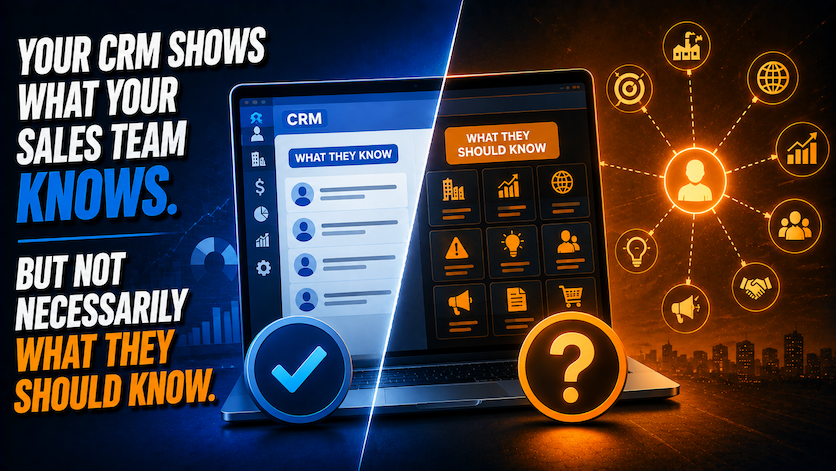
Traditional target customer identification reduces companies to just a few data fields
Let’s take a provider of a tool monitoring solution for CNC machines.
Its traditional target audience might be:
Metalworking companies in Germany with 50 to 500 employees.
That’s a great way to search.
A company database will likely return thousands of results.
The only problem is:
A company may be in the metalworking industry but still not have its own CNC manufacturing capabilities.
It may use CNC machines but only produce very simple components.
It may own the appropriate machines but have absolutely no need for tool monitoring.
Industry, revenue, and number of employees define a market.
However, they do not explain why a particular company is a good fit for a specific offering.
It is precisely this limitation of traditional target audience definition that our cluster on modern B2B target customer search addresses. Modern research therefore supplements traditional company data with products, technologies, manufacturing processes, applications, and recognizable changes.
The flaw lies in the way we search
Most sales databases operate on a simple principle.
They have data fields.
Industry.
Region.
Number of employees.
Revenue.
Legal structure.
Perhaps also growth, software used, or some technology data.
The sales team combines these fields and generates a list.
The problem isn’t with this data.
The problem arises when we assume that this list already contains our target customers.
Initially, it only includes companies that meet certain formal criteria.
We don’t yet know whether they’re truly a good fit from a business perspective.
Modern customer research therefore flips the logic on its head.
We don’t start by asking:
“Which data fields can I filter?”
But rather:
“What characteristics would a company need to have for my offering to be relevant there?”
And only then do we consider how we can research exactly those characteristics.
From Target Audience Filter to Searchable Customer Profile
This fundamentally changes the way we search for customers.
A modern search process examines a company from multiple perspectives.
First, traditional company characteristics help narrow down the potential market.
Then it gets more technical.
What does the company produce?
What products does it offer itself?
What materials does it process?
What technologies does it use?
What manufacturing processes does it use?
What are the applications?
And finally:
What changes are currently taking place?
Is the company investing?
Is it building a new facility?
Is it hiring specific specialists?
Is it introducing new products?
Is it expanding its capacity?
It is only through this combination that a picture emerges that is truly interesting for sales. The bloola methodology for B2B target customer search describes precisely these levels of research.
An abstract characteristic must become a tangible clue
This presents another challenge.
Many characteristics of a good customer cannot be searched for directly.
“Innovative company,” for example, sounds like a sensible criterion.
But what do you actually type into a search engine for that?
This characteristic only becomes interesting when we ask:
How would we know that a company is innovative?
Perhaps it regularly releases new products.
Maybe it’s looking for development engineers.
Maybe it’s investing in new manufacturing technologies.
Maybe it’s building a new production facility.
Suddenly, an abstract concept gives rise to concrete, publicly visible indicators.
It is precisely this step that is crucial.
Characteristics become searchable signals.
And thus, a theoretical target audience definition gives rise to a search model.
AI primarily changes the depth of research
This type of research was, in principle, possible even before artificial intelligence.
It was simply not economically scalable.
A sales representative could visit the websites of 500 companies.
They could read product catalogs.
Review job postings.
Search through press releases.
Analyze technical PDFs.
Research equipment fleets.
And then evaluate how well each company fits with his own offering.
But that would take weeks.
AI therefore changes not so much the fundamental logic of the research as its scalability.
It can analyze publicly available information from various sources, compare characteristics, and evaluate clues based on how well they match a previously defined search profile. The underlying sources range from company websites and job postings to product catalogs, technical documents, and press releases. Nevertheless, individual signals should always be evaluated for timeliness, source, and relevance.
An example: 200 relevant accounts out of 10,000 companies
Let’s imagine a provider of industrial automation.
A traditional search might look like this:
Manufacturing companies in Germany with 100 to 1,000 employees.
The result would be massive.
Hardly useful for the sales team.
Modern research therefore asks additional questions.
Which companies have their own production processes that can be automated?
Where are large quantities produced?
What manufacturing processes are used?
Which companies are currently looking for automation engineers?
Where are production capacities being expanded?
Which locations are investing in new production lines?
This isn’t meant to be an exhaustive list.
On the contrary.
It’s getting shorter.
But there’s a clear rationale for every remaining account.
The actual goal of modern research is therefore not to
to find as many companies as possible.
Rather:
to pass on as few incorrect companies as possible to the sales team.
On the bloola page about B2B target customer search, this logic is described as a path from a very large potential market to a manageable number of target customers that can be justified on a professional basis.
But even a perfect target customer is not yet an opportunity
At this point, we need to draw an important line.
Once we’ve found a company that’s a perfect fit for our offering, all we know at first is:
This company might need our product.
We don’t yet know:
-
whether there is actually a need.
-
whether this need is currently a priority.
-
whether a budget is available.
-
whether a competitor is already established.
-
or whether a purchase decision is even on the horizon.
That’s why modern customer acquisition doesn’t end with finding the right company.
After
“Who’s a good fit?”
comes
“Why might this company have a need?”
and finally
“Why right now?”
This is exactly where the new approach to identifying target customers intersects with commercial intelligence.
The Real Change
The difference between traditional and modern customer search, therefore, does not lie in the fact that we use a better database.
We’re changing the search logic.
In the past, we segmented markets and then filtered out companies.
Today, we can describe the business, technological, and operational characteristics that define a relevant customer and search specifically for visible evidence of them.
This also changes the role of the Ideal Customer Profile.
An ICP must not only describe who theoretically fits our profile.
It must be searchable.
An Ideal Customer Profile thus evolves into a Need Profile.
A profile that describes how we can actually identify a potential need.
That is the starting point for Demand Discovery.
Conclusion
The key question in modern customer acquisition is no longer:
“Which companies are in my target audience?”
But rather:
“What visible characteristics indicate that this company might actually be relevant to my offering?”
The better a company can answer this question, the less new customer acquisition depends on large lists, chance, and gut feelings.
And the more likely it is that high-fit accounts will emerge—where the sales team can explain why they specifically want to engage with this company.
You can find the detailed methodology, including the various research levels and concrete examples, in our cluster “Finding B2B Target Customers.” Finding B2B Target Customers: The Overall Method
This leaves one crucial question:
Is your Ideal Customer Profile merely well-described today, or can it actually be used to search for companies?
In the next post
In the next post, we’ll go a step deeper.
Because even though we’ve learned not to define target customers solely by company size, region, and industry, one important question remains:
Which characteristics actually tell us whether a company might need our offering?
Especially in industrial B2B sales, SIC, NACE, or other industry codes are often insufficient for this purpose.
Two companies can belong to the same industry and still have completely different production processes, machinery, materials, and technical requirements.
Conversely, companies from different industries may use the same manufacturing process and therefore be highly relevant to the same supplier.
In the next post, we’ll therefore show:
Need Over Industry
Why manufacturing processes often reveal more about potential demand than SIC or NACE codes, and how this changes the search for new customers.
If you want to not only understand AI but also implement it systematically in your company, then: