Why Data Alone Doesn't Improve Sales
We live in the age of data.
Companies are investing millions in CRM systems, data warehouses, business intelligence, data lakes, and AI platforms.
Never before has so much information been available.
And yet, many sales managers are asking themselves the same question:
Why isn’t this actually making our sales better?
The answer is surprisingly simple.
Data doesn’t generate decisions.
People do.
More data does not mean more insight
Many companies believe that better data automatically leads to better decisions.
But that’s often not what happens.
Instead, what results are:
- larger databases,
- more dashboards,
- additional reports,
- more complex analyses,
- and an ever-growing number of metrics.
The volume of information is growing.
The quality of decision-making often does not.
After all, information alone doesn’t answer any questions.
It merely provides possible answers.
Data lacks context
A piece of information such as
"The company has 850 employees."
is, at first glance, value-neutral.
Similarly:
"The company is investing in a new production facility."
Or:
"Revenue has increased by 18 percent over the past three years."
Any of these pieces of information can be important.
Or completely meaningless.
It’s the context that determines its significance.
Is the company even a target customer?
Does the investment have anything to do with our offering?
Does this create a specific need?
Which competitors are involved?
Without this context, data remains isolated facts.
Sales doesn’t need data.
They need answers.
A salesperson doesn’t want to open an Excel spreadsheet first thing in the morning.
They want to know:
- Which companies should I reach out to today?
- Why these in particular?
- What problem am I solving there?
- Who makes the decisions?
- What are my chances of success?
No single data source can answer these questions.
Only the intelligent integration of various pieces of information leads to a sound decision.
Data only becomes valuable through interpretation
The real challenge, therefore, does not lie in collecting data.
It lies in interpreting it.
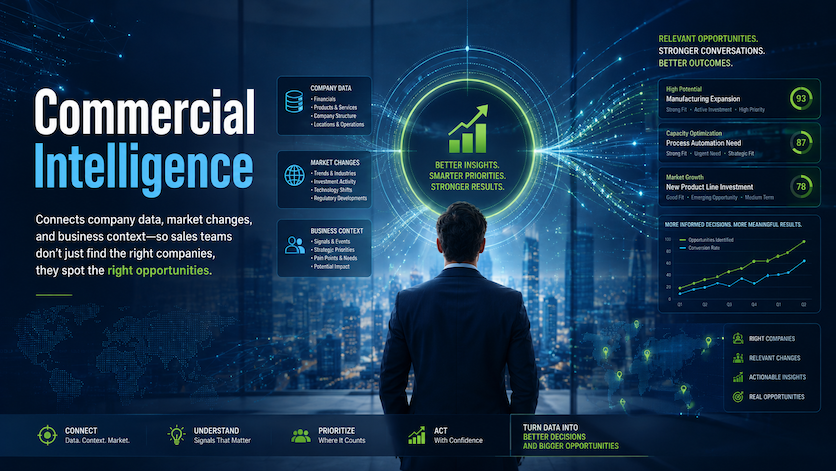
Commercial Intelligence combines information from different perspectives.
Market trends.
Company data.
Signs of demand.
Competitive intelligence.
Business context.
These individual pieces of information come together to form a complete picture.
And from this overall picture, a decision is made.
That is precisely where the difference lies.
Why AI Alone Doesn’t Solve the Problem
With the rise of generative AI, many companies believe that the data problem will resolve itself.
But even AI needs context.
It must understand
- what is being searched for,
- what information is relevant,
- what connections exist,
- and what decision should ultimately be made.
Without this framework, even the best AI will provide plausible answers—
But not necessarily the right ones.
That is why the real added value does not come from artificial intelligence alone.
It comes from a clear methodology that structures, evaluates, and contextualizes information.
Commercial Intelligence Turns Data into Decisions
Commercial Intelligence therefore takes a different approach.
The focus isn’t on the data.
Rather, the focus is on the decision.
Each piece of information is evaluated based on whether it helps make a better sales decision.
Out of thousands of data points, only a few insights remain in the end.
It is precisely these insights that determine
- which companies to prioritize,
- when the right moment has arrived,
- which arguments are most persuasive,
- and which opportunity promises the greatest success.
The real currency is confidence in decision-making
Companies often talk about data quality.
Perhaps that isn’t the decisive metric at all.
The real currency of modern sales organizations is decision confidence.
The better a company can decide
- which opportunities to pursue,
- which markets are attractive,
- which customers offer the greatest value,
- and which resources to allocate,
the more successful its sales operations will be.
Data is merely the raw material in this process.
Conclusion
Data has no value on its own.
It only gains value when it helps make better decisions.
Commercial Intelligence, therefore, does not simply collect as much information as possible.
Instead, it connects the right information, places it in the appropriate context, and derives concrete recommendations for action from it.
After all, it’s not the volume of data that determines sales success.
Rather, it’s the quality of the decisions that result from it.
That is precisely the difference between a data-driven organization and one that makes intelligent decisions.
👉 Recommendation
In addition to manual research, we’ve developed automated tools for you:
bloo.research - Find the right B2B companies in minutes
bloo.radar - Find out what your competitors are up to next at
before they do.
🚀 Next Step
If you want to not only understand AI but also implement it systematically in your company, then:
👉 Learn more about our AI training program:
https://bloo.school
👉 Learn more about our Smart Market Fit offerings:
https://bloola.com/smf - The Smart Market Fit Course
https://bloola.com/smf-system - The Smart Market Fit System for Businesses
👉 Or learn more about our consulting and automation solutions:
https://bloola.com