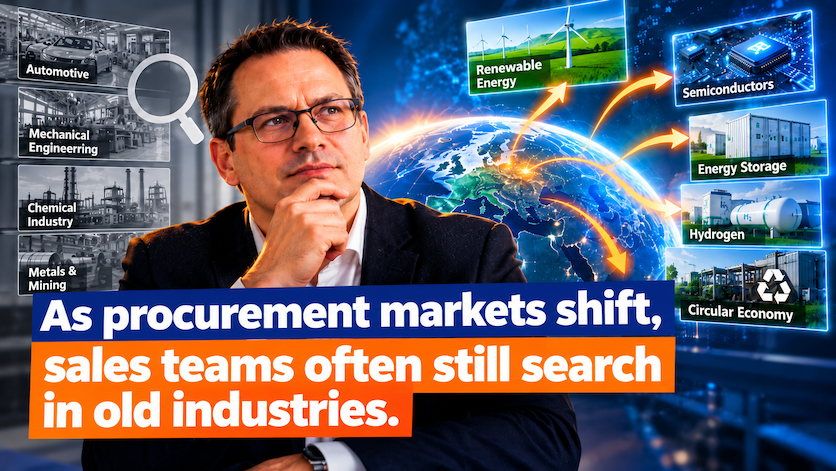
"Why needs arise from processes, technologies, and changes—not from industries."
Companies rarely buy a product just because it’s well described. They invest because something is changing and a new need arises.
In sales, we talk a lot about products—about functions, performance features, quality, prices, and benefits. We explain what a solution can do, how it’s structured, and why it’s supposed to be better than other offerings.
From the provider’s perspective, this makes sense. After all, a lot of time has been invested in development. The product is at the heart of the company and shapes its day-to-day work.
For the customer, however, the world looks different.
A company usually doesn’t engage with a product simply because it finds that product particularly exciting. It engages with it because a process is no longer working, a technology needs to be replaced, a new requirement has arisen, or a change needs to be managed.
The product is therefore rarely the starting point.
It is a possible solution to a problem.
Industries describe markets, but not specific needs
Many sales organizations initially structure their market by industry. For example, a provider might decide that machinery manufacturers, chemical companies, or logistics firms belong to its target audience.
This makes sense, as industries help narrow down markets. They provide insights into which products are used, which processes are typical, and what requirements might generally arise.
Nevertheless, a need does not arise simply because a company belongs to a particular industry.
A machinery manufacturer does not automatically need a new automation solution. A chemical company does not necessarily invest in measurement technology. A logistics firm does not always build a new warehouse.
Only when something changes within these companies does a concrete need arise.
Perhaps production volumes are increasing. Perhaps a new product is being introduced. Perhaps existing processes can no longer be operated economically. It’s possible that legal requirements, supply chains, or customer requirements are changing.
The industry defines the framework.
The need arises from the situation within that framework.
Companies buy progress
A company doesn’t buy a machine simply because it wants to own one. It buys it because it wants to produce faster, improve quality, increase capacity, or reduce costs.
It doesn’t buy software simply because software is inherently interesting. It invests because information is lacking, processes are too slow, or existing systems are no longer sufficient.
It doesn’t hire a consultant because consulting is a goal in itself. It seeks support because a decision needs to be prepared, a change needs to be implemented, or a problem needs to be solved.
At its core, therefore, a company does not buy an object or a service.
They buy an improvement.
This improvement can be economic, technical, or organizational in nature. It can reduce risks, enable growth, ensure quality, or save time.
The product remains important. But its significance arises only from the progress it enables for the customer.
The need arises from the process
Especially in B2B business, many needs arise from operational processes.
A production line is reaching its capacity limit. The error rate is rising. A manual step is causing excessive costs. Information has to be entered multiple times. A piece of equipment requires more and more maintenance. Delivery times are becoming too long, or quality can no longer be maintained consistently.
In these situations, the customer does not initially think in terms of product categories.
They think in terms of problems and goals.
They ask themselves how they can process more orders, avoid downtime, speed up processes, or reduce costs. It is only in the course of this search that the question arises as to which technology, machine, or service might be suitable.
For sales, this sequence is crucial.
Those who focus solely on their product start their line of thinking too late. Those who understand the customer’s process recognize why an offer might be relevant in the first place.
Technology changes needs
Needs don’t arise solely from problems. They can also be triggered by new technical possibilities.
A technology becomes more affordable, more powerful, or easier to use. This enables processes that were previously too expensive or too complex. Companies begin to reevaluate existing workflows.
Automation can replace manual tasks. Artificial intelligence can analyze information more quickly. New materials enable different products. Modern sensor technology improves the monitoring of systems. Cloud technologies are changing the way systems are deployed and operated.
However, such developments do not automatically lead to investments.
Only when a new technology aligns with a specific process, an economic advantage, and a genuine willingness to change does a relevant need arise.
The question is therefore not just:
Which companies could use this technology?
But rather:
For which companies does this technology currently solve a relevant problem or enable a concrete improvement?
Change sets decisions in motion
Many purchasing decisions begin at a moment when the current situation is no longer sufficient.
A company wins a new major client and needs additional capacity. A facility is being expanded. There’s a change in leadership. A competitor launches a new solution on the market. New regulations increase the pressure to act. There’s a shortage of skilled workers. Energy costs are rising. An old piece of equipment is reaching the end of its life cycle.
Such changes set decisions in motion.
They create a gap between the current state and the state the company must achieve in the future.
It is precisely this gap that creates a need.
The greater the pressure to change and the clearer the desired goal, the more likely an investment becomes.
This does not mean that every change automatically leads to an order. But it creates a significantly better starting point than simply belonging to an industry.
The same product serves a different purpose in every company
A product may be purchased by different customers for completely different reasons.
A new production facility can enable growth at one company. At another, it replaces an outdated machine. A third company wants to use it to save energy, while a fourth needs to achieve better product quality.
Technically, it may be the same solution.
From a business perspective, however, there are four different reasons for the purchase.
This has a direct impact on how you address them.
Sending the same product message to all companies ignores their respective situations. The communication remains general, even though the reasons for an investment are very specific.
A relevant conversation therefore does not begin with a complete description of the product.
It begins with understanding the challenge the customer needs to solve.
Why Product Arguments Often Come Too Soon
Many sales pitches start with statements like:
“We offer an innovative solution for …”
or:
“Our products are known for their high quality and efficiency.”
Such statements may be true. However, they assume that the listener has already recognized why they should be interested in the product.
That is often not the case.
A CEO, production manager, or buyer doesn’t evaluate an offer based on its features first. Instead, they first ask themselves whether the topic is even relevant to their current situation.
Without this connection, even a good product remains just another piece of information.
That’s why the sales team shouldn’t start by explaining what they want to sell. They should first understand what change, process, or goal the customer is currently focused on.
Only then do the product’s features take on meaning.
From the Ideal Customer Profile to the Customer’s Needs
Traditional Ideal Customer Profiles often describe the industry, company size, region, revenue, and typical points of contact. These characteristics help identify companies that are generally a good fit.
However, they should be supplemented with the need scenario.
A more complete picture could describe not only who a potential customer is, but also what needs to happen there for a need to arise.
For an automation technology provider, this could include rising production volumes, a shortage of skilled workers, high manual workloads, or the setup of a new production line.
For an IT service provider, outdated systems, company growth, new security requirements, or the integration of multiple locations could play a role.
For a technical service provider, the age of equipment, new environmental regulations, quality issues, or planned expansions could be decisive factors.
The industry indicates where to look.
The demand situation explains why a particular company is of interest right now.
What This Means for Sales Research
Sales research should therefore not merely collect company data. It should seek to understand the business context.
Which processes are critical for the company? What technologies are used? Where might bottlenecks arise? What changes are evident? What goals is the company pursuing? And where could your own offering make a credible contribution?
These questions do not automatically lead to a reliable sales forecast. However, they create a much better foundation for prioritization and outreach.
The sales team then no longer approaches a company simply because it formally belongs to the target audience.
They approach it because there is a clear connection between the company’s current situation and their own offering.
This is exactly where data becomes relevant
Commercial Intelligence therefore views companies not merely as data sets consisting of industry, revenue, and number of employees.
It views them as living organizations with processes, technologies, goals, and changes.
The crucial question is not:
Which company could use our product?
But rather:
What challenge is currently emerging, and which companies need to solve it?
This shift in perspective is important because it moves sales away from focusing on the product itself and closer to the customer’s reality.
This doesn’t mean the product disappears from the sales process. On the contrary: it becomes easier to understand and more valuable because it’s linked to a specific challenge.
Conclusion
Companies don’t buy products for their own sake.
They invest because processes need to be improved, technologies need to be updated, problems need to be solved, or changes need to be managed.
Industries help structure potential markets. However, they do not explain why a specific company is developing a particular need at this moment.
The actual reason for the purchase runs deeper. It arises when the current state of affairs is no longer sufficient and a company must—or wants to—make a change.
For sales, this means: Think less about products and start discussing processes, goals, and changes sooner.
After all, simply knowing which industry a company belongs to is not enough to understand its market.
But those who understand what challenge is currently emerging there may recognize an opportunity.
Next Article: CI-003
Why We Look for Companies Even Though We Should Be Identifying Needs
How Traditional Target Audiences Obscure the View of Real Business Opportunities
The next article explores why sales organizations usually start their search with companies and contacts—and how the results change when the starting point is a specific need instead.
👉 Recommendation
In addition to manual research, we’ve developed automated tools for you:
bloo.research - Find the right B2B companies in minutes
bloo.radar - Find out what your competitors are doing next
before they do.
🚀 Next Step
If you want to not only understand AI but also implement it systematically in your company, then:
👉 Learn more about our AI training:
https://bloo.school
👉 Learn more about our Smart Market Fit offerings:
https://bloola.com/smf - The Smart Market Fit Course
https://bloola.com/smf-system - The Smart Market Fit System for Businesses
👉 Or learn more about our consulting and automation solutions:
https://bloola.com