Share this
by Lars-Thorsten Sudmann on Nov 18, 2026, 8:41:06 PM
Why 50 highly relevant prospects can be more valuable than 500 generic business contacts
Many machinery and equipment manufacturers face a similar challenge: Their products are technically sophisticated, their solutions are proven, and their sales teams have extensive industry experience. Yet systematically acquiring new customers beyond existing business relationships remains difficult.
Sales teams often rely on personal networks, referrals, trade shows, and long-standing customer relationships. To identify additional prospects, they turn to Google, LinkedIn, or traditional company databases.
The problem is that these methods primarily identify companies belonging to a particular industry. They rarely reveal whether those companies actually need the machinery or equipment being offered.
The key question is therefore not: How can we find as many new business contacts as possible?
It is: How can we identify companies for which our machinery provides genuine technical and economic value?
1. Why Traditional Target Customer Profiles Are Often Too Broad
Consider a manufacturer of industrial packaging machinery.
Its sales team is looking for new customers in the food industry. A conventional company database provides thousands of food manufacturers.
However, this list leaves several important questions unanswered.
Which companies process products that can be packaged using the manufacturer's machines? Which packaging materials and technologies do they use? What production capacities do they require? Which companies might be planning to modernize their packaging lines?
A food manufacturer with 500 employees might be an excellent potential customer. Another manufacturer of the same size, operating in the same industry, might be completely unsuitable.
The difference often lies in their products, manufacturing processes, and technical requirements.
Industry classification, revenue, and employee count alone are therefore insufficient to identify truly attractive sales opportunities.
2. A Better Approach: Start With Your Product and Work Backward to Customer Needs
Effective customer acquisition begins with a detailed understanding of your own products and capabilities.
What functions do your machines perform? Which products can they manufacture or process? Which materials and production methods are compatible with your equipment? What specific operational problems do your machines solve?
These questions help establish the characteristics of companies that could benefit from your offering.
For a packaging machinery manufacturer, relevant criteria might include specific food categories, packaging formats, production volumes, or automation requirements.
Together, these criteria form the foundation of a precise Ideal Customer Profile (ICP).
Unlike traditional customer segmentation, this approach focuses less on industry labels and more on whether a company is genuinely suitable as a customer.
It can also reveal opportunities in previously overlooked markets. A machinery manufacturer may discover companies outside its traditional target industries whose production requirements closely match its equipment capabilities.
3. From 500 Potential Contacts to the 50–75 Most Promising Prospects
Identifying a large pool of potential customers is only the starting point.
The real business value comes from qualifying and prioritizing those companies.
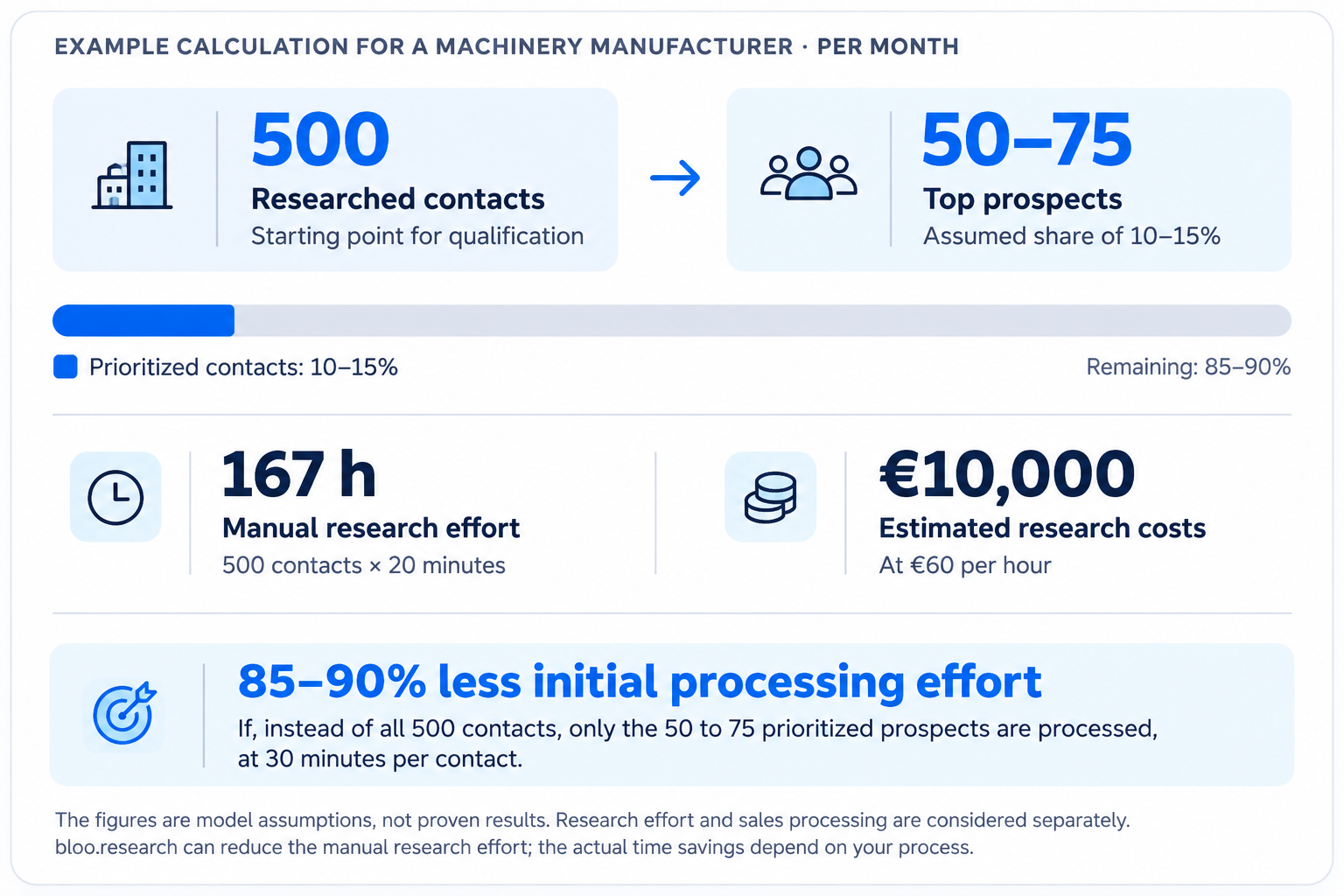
Imagine a machinery manufacturer researching 500 potential contacts every month.
Not every contact will be equally valuable. Some companies may not be a sufficiently good technical fit. Others may have no identifiable need or offer limited commercial potential.
For planning purposes, assume that 10–15% of those contacts represent particularly attractive sales prospects.
That translates into 50–75 prioritized prospects per month.
This percentage is a planning assumption, not a universally proven conversion or qualification rate. The important point is that prioritization is based on clear, relevant criteria.
Four questions are particularly important:
Technical fit: Do the company's products, manufacturing processes, and operational requirements align with our machinery?
Specific application: Is there a recognizable use case where our equipment could deliver value?
Commercial potential: Is the company attractive in terms of its size, production structure, and potential order value?
Demand and timing: Are there indications of investments, modernization projects, capacity expansion, or changing production requirements?
The more of these criteria a company meets, the more relevant it becomes for targeted sales outreach.
However, being a good fit does not necessarily mean a company is ready to buy. Research establishes a reasoned basis for prioritization. Actual purchasing intent still needs to be validated by the sales team.
4. Why Focusing on Fewer Prospects Can Improve Sales Productivity
Salespeople have limited time.
They need to research potential customers, identify decision-makers, prepare conversations, initiate contact, and manage existing sales opportunities.
When a salesperson approaches 500 companies with the same level of effort, valuable time is inevitably spent on businesses that may have little potential.
By focusing on 50–75 carefully selected prospects, the sales team can work much more selectively.
Salespeople can examine each company's products and manufacturing processes and adapt their outreach to specific technical or operational requirements.
The objective is not to process the largest possible number of contacts. It is to generate more qualified sales opportunities per hour invested.
A Simple Calculation
Assume that the initial preparation and outreach process takes an average of 30 minutes per prospect.
Processing 500 contacts would require 250 working hours.
Focusing on 50–75 prioritized prospects reduces this initial processing effort to approximately 25–37.5 hours.
That represents an 85–90% reduction in the time spent on this particular stage of the sales process.
This is a hypothetical comparison. Research and qualification activities are not included, and a more personalized approach to high-value prospects may require additional time per contact.
The available sales capacity can instead be invested in customer conversations, technical consultations, proposal development, and managing existing opportunities.
In machinery and equipment manufacturing, where individual contracts can represent substantial revenue, winning one additional highly suitable customer may be far more valuable than collecting hundreds of generic business contacts.
5. Buying Signals Help Identify the Right Timing
A company's technical suitability answers one important question: Could this company benefit from our products?
Successful outreach also depends on timing.
Certain business developments may indicate that a company could require additional machinery or equipment.
Examples include expanding a production facility, introducing new product lines, investing in automation, or upgrading existing manufacturing processes.
Such developments do not automatically indicate purchasing intent.
However, they provide useful reasons to investigate a company more closely and develop a relevant, well-informed approach.
Combining technical fit, commercial attractiveness, and relevant business developments creates a much stronger basis for sales prioritization than a conventional company list.
6. The Real Challenge: How Can This Approach Be Implemented Efficiently?
The methodology described above can be implemented without specialized software.
A salesperson could research companies individually, analyze their product portfolios, investigate their manufacturing processes, and search for indications of relevant business developments.
The challenge is the amount of work involved.
Assuming an average of 20 minutes of manual research per company, researching 500 contacts requires approximately 167 working hours per month.
At an estimated internal labor cost of €60 per hour, this represents approximately €10,000 in monthly research costs.
Additional time may be required to evaluate and prioritize the findings.
Systematic customer research therefore makes commercial sense, but only if the process is efficient enough to justify the resources invested.
7. How AI-Powered Research Reduces the Workload
This is where specialized research solutions such as bloo.research become relevant.
Instead of manually investigating companies one by one, the process starts by analyzing the machinery manufacturer's products, applications, and technical capabilities.
These insights are translated into specific research profiles.
bloo.research uses these profiles to systematically identify potential customers and qualify them based on their products, manufacturing processes, applications, and potential needs.
The standard package includes research capacity for 500 contacts per month.
Using the planning assumption that 10–15% represent particularly attractive prospects, this provides a potential shortlist of 50–75 prioritized contacts each month.
The main advantage is that substantial parts of the research and initial qualification process can be handled systematically.
Salespeople no longer need to investigate every potential customer from scratch.
The previously calculated 167 hours of manual research serve as a benchmark for comparison. They do not represent guaranteed time savings, as the actual reduction depends on existing processes and the level of additional validation required.
What Sales Teams Gain
Rather than spending most of their time searching for potential customers, salespeople can concentrate on assessing and engaging the most promising prospects.
The research findings provide a more relevant starting point for personalized outreach and better-informed sales decisions.
This turns time-consuming individual research into a repeatable process, with the manufacturer's own product portfolio serving as the foundation for identifying new customers.
Conclusion: Not More Contacts. More of the Right Customers.
Successful customer acquisition does not begin by asking how many companies are available in a database.
It begins by understanding which companies could actually use your products and which applications, technical requirements, or business developments might create demand.
Manufacturers that systematically research and prioritize prospects based on these factors can deploy their sales resources more effectively and improve their chances of identifying commercially attractive opportunities.
With AI-powered solutions such as bloo.research, this approach can be applied across larger target markets while significantly reducing the need for manual research.
Which Companies Could Benefit From Your Machinery?
Find out which potential customers outside your existing sales network match your products, technologies, and applications.
Learn more about bloo.research
Take action now
Try out this approach for yourself. In our meeting, we will show you how your sales team can harness the power of AI technology.