Share this
by Lars-Thorsten Sudmann on Nov 20, 2026, 1:42:05 PM
Why the right components, manufacturing capabilities, and procurement requirements are more important than the industry of potential customers
Industrial contract manufacturers often have highly specialized production capabilities. They produce turned and milled parts, machine sheet metal, weld assemblies, process plastics, or manufacture complex components according to customer specifications.
Their machinery, manufacturing processes, and technical expertise form the foundation of their business model.
The challenge lies in continuously finding new customers whose parts are a good fit for these manufacturing capabilities.
Many contract manufacturers secure orders through existing business relationships, referrals, requests for proposals, and direct inquiries. In addition, the sales team researches potential customers through industry directories, Google, or LinkedIn.
The problem: A company’s industry reveals very little about what components it needs, what manufacturing processes are required for them, and whether outsourcing is a viable option.
The key question is therefore:
Which manufacturers need components that we can produce cost-effectively using our machines, processes, and technical expertise?
Those who systematically analyze these relationships can identify new customers more effectively and utilize their manufacturing capacity with economically attractive orders.
1. Why traditional industry lists are often unsuitable for contract manufacturers
Let’s take the example of a medium-sized contract manufacturer that specializes in CNC-milled parts made of aluminum and stainless steel.
Its machinery enables the precise machining of complex components in small and medium-sized production runs.
A traditional sales research approach might identify companies in the mechanical and plant engineering sectors.
However, not every company in this industry requires the manufacturing services offered.
One machinery manufacturer primarily uses standardized off-the-shelf parts. Another requires extensive welded structures. A third develops machines with numerous custom-designed precision components.
The third manufacturer, in particular, could be an interesting customer.
Other potential customers may be found among manufacturers of medical technology, measuring instruments, automation technology, or industrial testing systems.
These companies operate in different industries. What they have in common is a potential need for precision-manufactured metal components.
Therefore, the search for new customers should not begin with general industry characteristics.
The key factors are which products a manufacturer develops, which components are used in them, and which manufacturing processes are required to produce them.
2. The better approach: From your own machinery to the right customer components
A systematic search for new customers begins with an analysis of a company’s own manufacturing capabilities.
Which components can be manufactured? Which materials can be machined? What dimensions, tolerances, and production volumes make economic sense?
For a CNC contract manufacturer, for example, the following criteria may be relevant:
- Three-, four-, or five-axis milling
- CNC turning and turn-mill operations
- Machining of aluminum, stainless steel, or engineering plastics
- Maximum workpiece dimensions and machining weights
- Achievable dimensional and geometric tolerances
- Surface requirements and post-processing methods
- Individual parts, prototypes, small batches, or recurring production runs
- Documentation, inspection, and quality requirements
Specific component groups can be derived from these capabilities.
For example, a company with high-precision five-axis milling machines could manufacture complex housings, mounts, functional parts, or mechanical components.
A facility with automated turning centers could be of interest to manufacturers who regularly require rotationally symmetric precision parts.
A sheet metal fabricator using laser cutting, press braking, and welding technology, on the other hand, is looking for different components and applications.
Combining manufacturing capabilities, component types, and economically viable batch sizes results in a precise Ideal Customer Profile (ICP).
The target group is thus defined not solely by industry and company size, but by the actual suitability of their products for the manufacturer’s own production processes.
3. The products of potential customers reveal their potential manufacturing needs
An important source of information is the products that a potential customer manufactures themselves.
A company that develops industrial measuring instruments may require precision-machined housings, mounts, or mechanical functional parts.
A manufacturer of automation systems may use milled parts, mounting plates, and custom machine components.
A supplier of packaging machines often requires mechanical components that are specifically designed for its systems.
Potential components and the necessary manufacturing processes can thus be identified based on the product range.
However, a distinction must be made between three situations.
Components that are already sourced externally
A manufacturer uses components produced by external manufacturing companies.
In this case, there is generally an opportunity to be considered as an additional or alternative supplier.
Components that have been manufactured in-house up to now
A company has its own manufacturing capabilities but could outsource certain production steps or components.
Possible reasons include capacity constraints, a lack of specialized machinery, or economic considerations.
New components resulting from product development
A manufacturer develops new machines, devices, or product generations.
This may result in additional components for which suitable manufacturing partners are needed.
All three situations can present interesting sales opportunities.
However, the product portfolio alone does not provide a reliable indication of whether a component is manufactured in-house or sourced externally.
This question must be examined during the further qualification process.
4. Why Manufacturers Need External Manufacturing Partners in the First Place
Not every manufacturer with suitable components is automatically a potential contract manufacturing customer.
The critical need often arises when external manufacturing offers technical, economic, or organizational advantages.
Lack of manufacturing technologies
A company needs a component that requires special machinery or processes to manufacture.
For example, highly complex five-axis machining, specialized welding processes, or precision machining under demanding quality specifications.
Limited manufacturing capacity
A manufacturer has its own production facilities but is unable to fully handle additional orders or certain peak workloads.
An external manufacturing partner can help bridge capacity bottlenecks.
In-house production that is economically unfeasible
It may not be cost-effective to manufacture certain components using our own machinery.
This can be particularly true for small batch sizes, frequently changing components, or rarely required specialized processes.
Additional Suppliers and Supply Security
A company may wish to expand its supplier base or reduce its dependence on individual manufacturing partners.
New Products and Development Projects
New product generations may require additional components, different materials, or new manufacturing processes.
In such situations, a technically qualified contract manufacturer can become a long-term production partner.
The specific need, therefore, does not arise solely from the existence of a component, but from the combination of manufacturing requirements and the potential benefits of outsourcing production.
5. Real-World Example: Finding New Customers for a CNC Precision Manufacturer
A medium-sized contract manufacturer has modern three- and five-axis milling machines.
It specializes in machining complex aluminum and stainless steel components and manufactures prototypes as well as small- and medium-volume production runs.
To date, the company has acquired new customers primarily through referrals, existing contacts, and incoming inquiries.
To systematically seek out new customers, the company will first determine which components can be manufactured—both technically and economically—using its existing machinery.
This process yields specific research criteria.
Of particular interest, for example, are manufacturers of automation systems, industrial measurement technology, test benches, or special-purpose machines.
These companies are evaluated to determine whether their products might contain complex mechanical components that align with the company’s own manufacturing capabilities.
The research focuses in particular on:
- What machines, devices, or systems a company manufactures
- Which mechanical components might be used in them
- Which materials and machining processes are relevant
- Whether new products or product generations are being developed
- Whether capacity expansions or changes in production requirements are foreseeable
- Which departments are responsible for design, production, and technical purchasing
The result is a selection of potential customers for whom a possible need for the offered manufacturing services can be technically justified.
Whether specific parts shown in drawings will be outsourced must then be clarified in a discussion.
The advantage is that the sales team understands which components might be relevant to the customer even before making contact.
6. Not every suitable manufacturing order is economically attractive
A contract manufacturer may be technically capable of producing a component, but the order may not be economically viable.
The actual attractiveness depends on several factors.
Technical Feasibility of Manufacturing
Is the component compatible with the available machines, machining processes, materials, and quality requirements?
Batch Sizes and Repetition Frequency
Is this a one-off part, a small production run, or a mass-produced part required on a regular basis?
Recurring orders can be particularly attractive because the setup processes and manufacturing procedures are already known.
Setup and programming effort
What kind of work planning, fixtures, programs, and inspection processes are required?
High setup costs can significantly impair profitability when production volumes are low.
Machine utilization and contribution margin
How well does the order match available capacity?
An economically attractive order should not only generate revenue but also make an appropriate contribution toward covering machine, labor, and operating costs.
Quality and Delivery Requirements
What tolerances, documentation, inspections, and delivery deadlines must the manufacturer meet?
Special requirements may result in additional costs and risks.
Long-term customer potential
How many different components might the customer need on a regular basis?
A manufacturer with an extensive product range and ongoing development may be more attractive in the long term than a customer with a single custom part.
The economic assessment should therefore not be based solely on the potential order volume.
The decisive factors are the combination of technical fit, manufacturing costs, repeat order frequency, and expected contribution margin.
7. Changes in the market create new production orders
Potential production needs often become apparent due to changes at the prospective customer.
A machine builder is developing a new generation of products. A manufacturer is expanding its production capacity. Another company is experiencing delivery problems with its existing suppliers.
Such developments can prompt a search for additional manufacturing partners.
Particularly interesting clues include:
- New generations of machines or equipment
- Expansions in production capacity
- Introduction of new materials or manufacturing methods
- Technical modifications to existing products
- New development and design projects
- Investments in new production lines
- Publicly Recognizable Supply Chain Issues
- Search for additional production or purchasing staff
- Changes in supplier and procurement strategies
This information should not be equated with specific production orders.
However, it helps identify companies that may have an additional or changing need for external manufacturing services.
8. Identify the 15 to 40 most promising manufacturing clients from 500 contacts
A systematic search for new customers can initially examine a larger pool of potential manufacturers.
The companies are then evaluated based on their products, component requirements, manufacturing processes, and potential procurement needs.
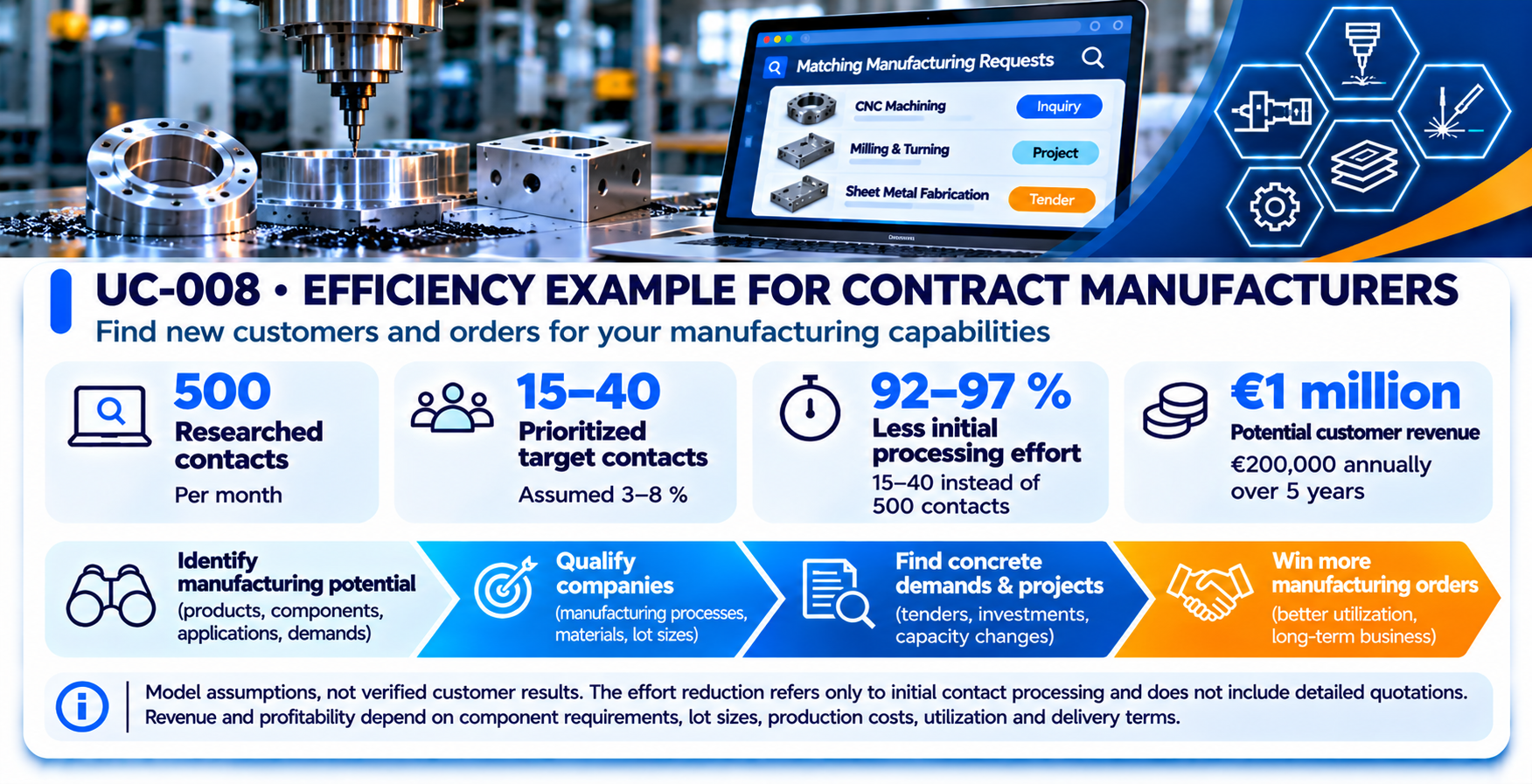
Let’s consider an example search involving 500 potential contacts per month.
For sales planning purposes, we assume that 3 to 8 percent of these are particularly well-suited to our own service portfolio and offer economically attractive manufacturing potential.
This corresponds to 15 to 40 prioritized leads per month.
Extrapolated over a year, this results in a theoretical potential of 180 to 480 prioritized contacts.
This figure is a model assumption and not a proven performance metric.
Depending on the manufacturing process, specialization, and economically viable batch size, it may vary significantly.
Furthermore, a prioritized contact does not constitute a confirmed production request.
It refers to a company whose products, components, and potential procurement requirements are particularly well-suited to one’s own manufacturing capabilities.
The sales department can then specifically evaluate these companies to determine whether there is an actual need for external manufacturing.
9. Why a new repeat customer can be valuable for years to come
Contract manufacturers often generate their revenue through recurring manufacturing orders.
A new customer may initially request a single component.
Following a successful initial production run and approval, further components, production runs, or additional projects may follow.
Sample Calculation: A New Customer for CNC Contract Manufacturing
A contract manufacturer secures a machine manufacturer as a client, for whom it regularly produces several different precision components.
Following a successful ramp-up phase, the estimated annual production volume is 200,000 euros.
Assuming a consistent supply relationship over five years, this corresponds to a calculated customer revenue of 1 million euros.
Additional product variants or other components could increase this volume.
Actual profitability depends on material costs, machine runtime, setup costs, scrap, quality assurance, capacity utilization, and agreed-upon prices.
This calculation is an illustrative example and not a sales forecast.
However, it demonstrates why a single, technically suitable repeat customer can be economically attractive over many years.
Especially when a manufacturer produces multiple components for the same customer, additional opportunities to utilize the machine fleet may arise.
10. How Better Target Customer Selection Reduces Sales Efforts
Acquiring new contract manufacturing customers can be time-consuming.
Before preparing a specific quote, technical requirements, potential manufacturing processes, materials, and production quantities must be evaluated.
Therefore, it makes good business sense to screen out companies with low manufacturing readiness early on.
Let’s assume that a sales representative needs an average of 30 minutes to prepare for and handle the initial contact with a potential customer.
For 500 contacts, that would amount to 250 work hours.
If, on the other hand, the sales team focuses on 15 to 40 prioritized contacts, the comparable initial processing time is reduced to 7.5 to 20 hours.
This corresponds to a calculated reduction of 92 to 97 percent.
This does not include preliminary research and qualification, as well as subsequent technical reviews, drawing analyses, and bid calculations.
The real advantage, therefore, lies in the fact that the sales department can focus its resources on those companies with which a technically and economically viable collaboration appears realistic.
11. The right contact person is often found in the design or purchasing department
When it comes to contract manufacturing services, purchasing decisions are often made through the collaboration of various departments.
The design department defines components and technical requirements.
The production department assesses whether and how a component can be manufactured in-house.
Technical purchasing seeks out suitable external manufacturing partners and evaluates prices, delivery terms, and availability.
Depending on the company’s structure, the following contacts may therefore be relevant:
- Technical Purchasing and Strategic Purchasing
- Head of Design and Product Development
- Production Management and Manufacturing Management
- Work Preparation and Production Planning
- Supply Chain Management
- Management at Smaller Manufacturers
When addressing this topic, it makes sense to distinguish between technical requirements and specific procurement decisions.
A general quote for CNC machining often provides little basis for a conversation.
An initial approach that refers to specific component groups, relevant materials, or recognizable product developments by the manufacturer, on the other hand, creates a more solid foundation for discussion.
12. The Challenge: Efficiently Researching Suitable Components and Manufacturing Requirements
The procedure described can, in principle, be carried out manually.
To do so, sales representatives would have to research numerous manufacturers, analyze their products, identify potential components, and evaluate the necessary manufacturing processes.
In addition, they would need to examine changes in product development and potential external procurement needs.
That takes time.
At an average of 20 minutes of manual research per contact, 500 contacts would require about 167 work hours per month.
Assuming internal labor costs of 60 euros per hour, this corresponds to a calculated monthly research cost of approximately 10,000 euros.
This model calculation does not yet include a detailed review of drawings or technical specifications.
In addition, much of the information regarding components, material requirements, and existing supplier relationships is not fully available to the public.
The actual production requirements must therefore be confirmed through direct contact with the customer.
The challenge lies in identifying, even before this time-consuming review, those companies whose capabilities are particularly well-suited to the company’s own manufacturing needs.
13. How AI-Powered Research Identifies New Contract Manufacturing Customers
This is where specialized research solutions like bloo.research can help.
The research begins with an analysis of the company’s own manufacturing capabilities.
Which components can be manufactured? Which materials are processed? Which manufacturing processes, machines, and quality requirements are relevant?
In addition, the study examines which batch sizes and order structures are particularly attractive from an economic standpoint.
This information is used to create specific research profiles.
This makes it possible to identify companies whose products and potential component requirements align with our own manufacturing capabilities.
Additional information regarding product developments, changes in capacity, or new production projects can be taken into account during the prioritization process.
The standard bloo.research package includes 500 researched contacts per month.
Assuming a hypothetical prioritization rate of 3 to 8 percent, this could result in 15 to 40 particularly relevant target contacts.
The key advantage is that the search for suitable manufacturers and component applications can be conducted systematically.
The sales team does not have to scrutinize every company from the ground up and can focus more on specific customer inquiries, technical discussions, and the development of long-term manufacturing relationships.
Whether a specific component is actually outsourced and whether its manufacture makes economic sense must then be evaluated based on specific customer information, drawings, and production volumes.
AI-powered research provides a better starting point for this.
However, it does not replace the technical feasibility study or the commercial cost analysis.
Conclusion: The best customers are a good fit for your own machinery
For industrial contract manufacturers, the most promising market potential lies with manufacturers whose products require components that can be produced cost-effectively using their own machinery and processes.
It is not just the industry or size of a company that matters.
More important are the components, materials, manufacturing requirements, batch sizes, and potential reasons for outsourcing.
By systematically analyzing these factors, companies can identify new customers whose needs align with their own machinery and who could award attractive long-term manufacturing contracts.
Of particular interest are companies with recurring needs, economically viable components, and a realistic opportunity for collaboration.
AI-powered research can help efficiently identify these companies even in larger target markets and reduce the effort required for manual research.
Which manufacturers need components that you can produce cost-effectively?
Find out which companies manufacture products whose components are compatible with your machines, processes, and manufacturing capabilities.
Learn more about bloo.research
Take action now
Try out this approach for yourself. In our meeting, we will show you how your sales team can harness the power of AI technology.