Share this
by Lars-Thorsten Sudmann on Nov 18, 2026, 11:24:33 PM
Why Technical Adaptability Opens Up New Markets and How Custom Solutions Can Lead to Long-Term Repeat Business
Many industrial component manufacturers have a proven portfolio of their own products. These form the technical foundation for solutions that can be tailored to specific customer requirements.
For example, a sensor manufacturer might modify the measurement range, connection geometry, or communication interfaces. A seal manufacturer might develop a custom seal geometry based on existing materials and manufacturing technologies. A drive manufacturer might adapt the gear ratio, design, or mounting to a specific machine.
The technical expertise is there. The products are proven. And the necessary adaptations can often build on existing development and manufacturing processes.
The real challenge lies in finding companies whose products require precisely these kinds of adaptations.
This is because potential customers aren’t necessarily looking for a specific component manufacturer. They’re looking for a technical solution that can be integrated into their own product.
This raises a crucial question for the sales team:
Which manufacturers develop or produce machines, devices, and systems for which our existing components represent a suitable solution with manageable modifications?
Those who systematically examine these relationships can tap into new applications and develop long-term supply relationships based on customer-specific solutions.
1. Why traditional industry research underestimates actual customer potential
Let’s take the example of a manufacturer of industrial pressure sensors.
Its product portfolio includes various sensor types with defined measurement ranges, designs, and electrical interfaces.
However, the products can be customized to meet specific customer requirements in terms of connection geometry, measurement range, housing material, or signal processing.
A traditional sales research approach would first identify companies that need pressure sensors.
But this search does not go far enough.
A manufacturer of hydraulic power units might need sensors with a specific connection geometry. A manufacturer of mobile machinery might require particularly robust designs with customized electrical interfaces.
A company that develops industrial test benches may be looking for sensors with specific measurement ranges and additional signal processing requirements.
All three companies have a need for pressure measurement technology. However, their requirements differ significantly.
Therefore, the decisive factor is not merely whether a company uses pressure sensors in general.
What is more important is whether the requirements of its products can be met using the sensor manufacturer’s existing technologies and customization options.
This expands the potential customer base beyond the standard applications of the past.
2. The Better Approach: From Product Portfolio to Custom Application
A systematic search for new customers begins with a detailed analysis of one’s own products and their customization options.
In this process, three levels must be distinguished.
The existing standard product
What technical functions do the existing components fulfill?
These include, for example, power ranges, materials, designs, electrical interfaces, mechanical properties, and relevant certifications.
These characteristics form the technical foundation.
Possible customizations
Which properties can be modified with reasonable effort?
For example, a component manufacturer could adapt existing products in terms of dimensions, connection types, materials, electronics, or performance parameters.
It is important to distinguish between simple variants, design modifications, and extensive new developments.
The Economic Limits
Not every technically feasible adaptation makes economic sense.
A manufacturer must therefore know which changes can utilize existing development and manufacturing processes, and at what scale of modification a custom solution becomes uneconomical.
This information is used to create an application-oriented Ideal Customer Profile (ICP).
Target companies are identified based on their products and technical requirements. At the same time, consideration is given to whether these requirements could be met using existing components and customization options.
The advantage: The sales team looks not only for existing areas of application but also for applications that can be tapped through manageable product modifications.
3. The most promising customers often have a specific technical requirement
For component manufacturers with a high degree of adaptability, companies that are not entirely satisfied with available catalog products are of interest.
For example, a manufacturer is developing a new machine with limited installation space.
While standard components fulfill the necessary technical function, they do not fit mechanically into the design in an optimal way.
Another manufacturer needs a component that meets specific requirements for temperature resistance, service life, or connection options.
A third company would like to replace several individual components with an integrated assembly.
Such requirements can serve as interesting starting points for a custom solution.
Situations in which the following apply are particularly relevant:
- existing standard products only partially meet the required specifications,
- special installation conditions require a customized design,
- special materials or surfaces are required,
- electrical or mechanical interfaces must be adapted,
- there are higher requirements for load capacity, precision, or service life,
- multiple technical functions are to be combined in a single component,
- an existing component needs to be optimized technically or economically.
These requirements cannot always be directly identified from publicly available information.
However, a company’s products, technical data, operating conditions, and development activities can provide clues as to where such requirements might arise.
It is precisely these connections that form the basis for targeted new-customer research.
4. Not every form of customization is economically viable
The ability to tailor products to customer requirements is an important competitive advantage.
However, it also carries an economic risk.
If a small order requires extensive development work, special tools, or additional manufacturing processes, a technically interesting project can become economically unattractive.
Therefore, when evaluating potential customers, the research should not focus exclusively on technical requirements.
Four factors are particularly important.
Technical Product Fit
To what extent can the customer’s requirements be met using existing standard products?
The more existing technologies and components that can be utilized, the lower the required development effort will be.
Customization and development effort
What changes would be required to integrate the component into the customer’s product?
It is important to distinguish whether existing variants can be combined, whether a design change is required, or whether extensive new development will be necessary.
Production potential
What quantities might the customer need on a regular basis following successful development?
A customer-specific component for a continuously produced machine series can be significantly more economically viable than a one-time custom-made part.
Long-term customer value
What revenue and contribution margin could be generated over several years?
In this context, development costs, potential tooling costs, manufacturing costs, start-up costs, and the expected duration of the business relationship should be taken into account.
An attractive target customer combines a good technical fit, reasonable customization costs, and sufficiently large long-term production potential.
5. Real-world example: A custom sensor for a machine manufacturer
A medium-sized manufacturer of hydraulic systems is developing a new generation of compact units.
To monitor operating pressures, the company needs sensors that can be integrated into the existing design.
Although the available standard products meet the basic measurement requirements, they do not have the optimal connection geometry.
A specialized sensor manufacturer offers a proven sensor platform that can be mechanically adapted.
Instead of developing a completely new sensor, the manufacturer could adopt the existing technology and modify the connection geometry accordingly.
The result is a component tailored to the customer’s specific application.
For the sensor manufacturer, this presents an opportunity to gain a new production-run customer without having to undertake a completely new development.
The key sales strategy is to identify such manufacturers based on their products, designs, and technical requirements.
The specific feasibility of a modification must then be assessed together with the customer.
6. Why a customized mass-production customer can be particularly valuable
The economic benefit often lies not only in the initial development order.
It arises above all when a customized component is successfully incorporated into a mass-produced product.
Let’s consider a simplified example.
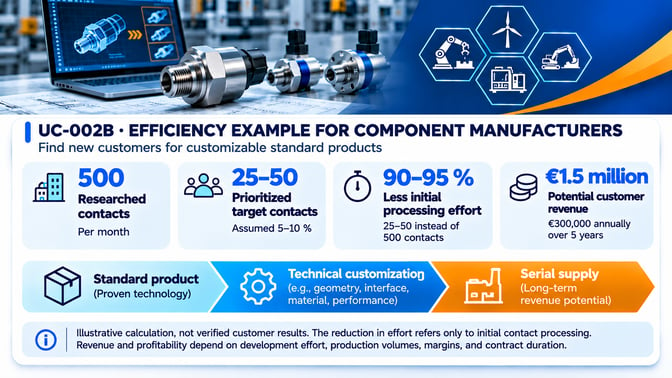
A machine manufacturer produces 1,000 units of a specific machine series annually.
Each machine requires two custom-made components.
Assuming a selling price of 150 euros per component, this results in an annual revenue potential of 300,000 euros.
Over five years, assuming constant production volume, price, and market share, this corresponds to a projected revenue of 1.5 million euros.
In addition, separate compensation for development or tooling services could be provided, provided this is contractually agreed upon.
This calculation is an illustrative example and not a revenue forecast.
However, it demonstrates the economic appeal of successful customization based on existing technologies.
A one-time customization effort can lay the groundwork for regular component deliveries.
In addition, additional product variants or further machine series from the customer can open up new sales opportunities.
However, profitability depends on development costs, the margin, the agreed-upon purchase quantities, and potential follow-up costs.
7. Identify the most economically viable applications from among 500 researched contacts
For highly customizable industrial components, the research process is more challenging than for standard catalog products.
A potential customer must not only have a suitable technical application.
Their requirements must also be economically feasible with the existing product platforms.
For an illustrative sales planning example, we’ll consider 500 researched contacts per month.
We assume that 5 to 10 percent of these can be prioritized as particularly interesting target contacts.
That amounts to 25 to 50 contacts per month.
This figure is a planning assumption and not a proven performance metric. It may vary significantly depending on the component, specialization, and adaptability.
The prioritized companies should, in particular, meet the following requirements:
Suitable Application: The company’s products or systems require technical functions that align with our own component portfolio.
Feasible Adaptation: The specific requirements appear to be fundamentally achievable based on existing technologies and manufacturing capabilities.
Reasonable development effort: The necessary modifications can likely be implemented without disproportionately high development or tooling costs.
Attractive mass-production potential: The company regularly manufactures machines, devices, or systems in which the components could be used.
Economic prospects: The potential purchase volumes and the duration of the customer relationship justify the necessary adaptation costs.
The goal is not to reach as many companies as possible.
The goal is to identify those manufacturers whose specific requirements represent a commercially viable application for our own product platforms.
8. New product developments create particularly attractive entry opportunities
An important time to approach potential customers is during the development of new products or product generations.
During this phase, components are selected, technical interfaces are defined, and suppliers are evaluated.
In contrast, for products already in series production, switching suppliers often involves additional testing, approvals, and organizational effort.
Therefore, the following developments may be of particular interest:
- Introduction of new generations of machines or equipment
- Development of more compact or higher-performance products
- Integration of new technologies and functions
- Changes to mechanical or electrical interfaces
- Increasing demands on precision, durability, or service life
- New variants of existing mass-produced products
- Technical optimizations to reduce manufacturing costs
- Replacement of existing components due to availability or quality issues
Such developments do not yet constitute evidence of a concrete procurement intention.
However, they do provide indications that a company may be selecting new components or reviewing existing solutions.
This creates an opportunity for the sales department to engage with design, product development, and technical purchasing at an early stage.
9. The right contact person is key to sales success
When it comes to customizable components, the purchasing decision is often not made solely by the purchasing department.
Technical suitability must first be evaluated by the relevant development and engineering departments.
Therefore, depending on the component, different points of contact may be relevant.
For mechanical components, design managers, development engineers, or technical project managers may be the appropriate contacts.
For electronic components, the electronics development, system architecture, or product management teams may be involved.
Technical purchasing becomes particularly important when it comes to supplier evaluation, pricing, contract terms, and subsequent volume procurement.
When approaching a target company, the sales team should therefore understand as precisely as possible what development objectives the target company is pursuing.
Instead of merely presenting existing products, the sales team can address a specific technical requirement and explain what customization options are generally available.
This creates a much better foundation for substantive discussions.
10. How a Targeted Selection Reduces Sales Effort
Sourcing customer-specific components can be time-consuming.
Even before an initial quote is provided, technical requirements must be understood, feasibility and the effort required for customization must be assessed, and potential production volumes must be evaluated.
That is why it is important to weed out unsuitable companies early on.
Let’s assume that a sales representative needs an average of 30 minutes to prepare for and make initial contact with a potential customer.
For 500 leads, this would require 250 work hours.
If the sales team focuses on 25 to 50 prioritized contacts, this initial effort is reduced to 12.5 to 25 hours.
This represents a 90 to 95 percent reduction in effort during this initial sales phase.
This calculation does not take into account the preliminary research and qualification or subsequent technical coordination. For high-value prospects, individual follow-up may also require more time per contact.
The real advantage lies in the fact that sales and application engineering can focus their resources on companies where an economically attractive, customer-specific solution appears realistic.
11. The Real Challenge: Efficiently Researching Technical Applications and Customization Needs
The procedure described can, in principle, be carried out manually.
To do so, sales representatives would have to examine numerous companies, analyze their product portfolios, evaluate technical specifications, and identify potential customization requirements.
This is particularly time-consuming when it comes to specialized components.
A single component can be used in a wide variety of products. At the same time, it is not always immediately clear whether existing standard products are sufficient or whether customer-specific modifications would be necessary.
With an average of 20 minutes of manual research per contact, 500 contacts would require approximately 167 working hours per month.
Based on imputed personnel costs of 60 euros per hour, this corresponds to a calculated monthly research cost of approximately 10,000 euros.
This model calculation does not yet take into account the in-depth technical review.
A systematic strategy for acquiring new customers is therefore particularly beneficial when the search for and initial evaluation of potential applications can be organized efficiently.
12. How AI-powered research identifies suitable customers
This is where specialized research solutions like bloo.research come into play.
The research begins with an analysis of the existing component portfolio.
This involves examining technical functions, product characteristics, potential applications, and relevant customization options.
This information is used to create specific research profiles.
Subsequently, manufacturers can be identified whose products and technical requirements might be compatible with the components offered and their possible modifications.
Additional information about product developments, new machine series, or technical changes can be taken into account during the prioritization process.
The standard bloo.research package includes 500 researched contacts per month.
Assuming a hypothetical prioritization rate of 5 to 10 percent, this can result in 25 to 50 particularly interesting target contacts.
The key advantage is that the search for technically suitable applications and manufacturers can be conducted systematically.
The sales team does not have to research every company from scratch and can focus more on technical qualification, customer outreach, and developing concrete supply relationships.
The actual suitability of a customer-specific solution must then be verified in collaboration with the design, development, and, if necessary, manufacturing departments.
The previously calculated 167 hours of manual research serve as a benchmark. The actual time savings depend on the previous research process and the technical follow-up work required.
Conclusion: Customized solutions based on existing products create long-term customer potential
For manufacturers of customizable industrial components, there is significant market potential among companies whose technical requirements are not fully met by existing products.
The key is the ability to cost-effectively adapt existing technologies and product platforms to specific applications.
A successful search for new customers should therefore not be limited to companies that simply need components that are generally suitable.
It should specifically identify manufacturers where technical requirements, feasible customization efforts, and long-term production potential align.
Those who systematically examine these interrelationships can tap into new applications, attract economically attractive customers, and deploy existing product platforms in additional markets.
AI-powered research helps efficiently implement this approach across larger target markets and reduce the manual research effort.
Which manufacturers might need your components in a customized form?
Find out which companies are developing products and systems in which your existing components could be used with specific modifications.
Learn more about bloo.research
Take action now
Try out this approach for yourself. In our meeting, we will show you how your sales team can harness the power of AI technology.