Share this
by Lars-Thorsten Sudmann on Nov 19, 2026, 7:16:24 PM
Why Successful Project Acquisition Doesn't Begin Only When a Request for Proposals Is Published
For companies in the fields of building services engineering, plant construction, and specialized technical services, calls for bids are a key component of acquiring new customers.
Whether it’s heating, air conditioning, and ventilation technology; electrical engineering; building automation; fire protection; energy supply; or technical operations services—many contracts arise in connection with larger construction, modernization, and investment projects.
Sales teams therefore often focus on tender platforms, procurement portals, and existing contacts with planners, general contractors, and clients.
However, this approach has a significant limitation.
By the time a request for proposals is published, the project is often already well underway. Technical requirements, scope of work, and procurement procedures may already have been established.
While companies can still submit a bid, they often have only limited influence on the technical design.
The crucial question is therefore not just:
Which tenders match our services?
But rather:
Which companies and organizations are currently planning projects where our technical services might be needed, and how can we identify these projects as early as possible?
Those who systematically analyze these connections can identify new project opportunities before they appear in traditional tender lists.
1. Why simply searching for tenders falls short
Let’s take a medium-sized provider of heating, ventilation, and air conditioning (HVAC) systems as an example.
The company regularly searches for tenders for ventilation systems, air conditioning, and building services equipment.
A tender platform returns numerous results.
However, some of these tenders do not align with the company’s own range of services. Other projects fall outside the economically viable scope of application. Still others have technical requirements that would necessitate additional partners or specialized qualifications.
There’s another problem as well.
The company may not learn about interesting projects until the technical specifications have already been finalized and the bid submission deadline is approaching.
Yet many of these projects are initiated much earlier.
An industrial company is planning to expand its production facilities. A hospital is modernizing its building systems. A logistics company is developing a new distribution center. A data center operator is planning additional technical infrastructure.
All of these projects can create a need for technical building equipment.
Information about these projects may already be available before a corresponding request for proposals is published.
Successful project acquisition should therefore not rely exclusively on searching through calls for bids, but should instead examine the entire market for relevant project developments.
2. The Better Approach: From Your Own Service Portfolio to the Right Project
Systematic project research begins with an analysis of the services offered.
What technical systems can the company design, supply, install, modernize, or maintain?
What project sizes are economically viable? Which regions are covered? What qualifications, certifications, and personnel capacities are available?
For a provider of technical building systems, the following service areas may be relevant, for example:
- Heating, ventilation, and air conditioning (HVAC)
- Electrical engineering and power supply
- Building automation and technical control systems
- Refrigeration and heating technology
- Measurement, control, and regulation technology
- Technical Fire Protection and Safety Technology
- Plant Modernization and Energy-Efficient Renovation
- Technical facility management and operational services
Specific project types can be derived from these services.
For example, a specialist in industrial refrigeration technology looks for cold storage facilities, food production sites, or buildings with specific temperature requirements.
A building automation provider, on the other hand, examines larger buildings with complex technical systems, a need for modernization, or specific requirements for energy efficiency and operational management.
An electrical engineering firm with experience in large-scale power distribution, in turn, might be of interest for the expansion of industrial or logistics sites.
This results in a project-oriented Ideal Customer Profile (ICP).
This profile describes not only the right client but, more importantly, the characteristics of a project for which the company’s services are well-suited.
3. Promising projects often become apparent long before the request for proposals is issued
Many larger investment projects leave publicly recognizable clues even in their early stages.
A company announces a site expansion. A municipality plans to build a new administrative building. An industrial company invests in additional production capacity.
Such developments can give rise to specific technical requirements.
The following information sources are particularly useful for research:
Investment announcements: Companies publish details of planned new construction, expansions, or modernizations.
Construction and planning projects: Publications regarding construction projects, zoning plans, or permitting processes can provide clues about upcoming projects.
Corporate news: New plants, production lines, or locations may create additional demand for building and plant engineering.
Project developers and general contractors: Published project portfolios can reveal which projects are being prepared or implemented.
Public procurement information: Preliminary notices, market surveys, and announcements may contain clues about planned contracts.
Job Postings: Job openings for project managers, civil engineers, or technical infrastructure managers may indicate ongoing or planned projects.
A single piece of information does not confirm a specific procurement need.
However, when taken together, these clues can reveal which projects are of particular interest to a specialized provider.
4. From Early Project Indications to Concrete Sales Opportunities
Not every announced construction or investment project automatically becomes a suitable contract.
For example, an industrial company may be planning a new production facility without the exact scope of the required building services equipment being publicly known.
Therefore, several questions should be examined for evaluation purposes.
What type of building or facility is being constructed?
What technical requirements are likely based on the planned use?
Which services are covered by the client’s own provider?
What phase of the project is the initiative in?
Who is the contracting authority, building owner, project developer, or planning firm?
What procurement and contracting structures are being considered?
An example:
A food manufacturer announces a new production facility.
Depending on the planned products and processes, the facility may require industrial refrigeration systems, ventilation systems, energy supply, building automation, or specialized utility supply.
A provider of these services may identify the project as potentially relevant as early as the planning phase.
Whether they can approach the client or the involved planning firms early on depends on the project and the intended procurement procedure.
Particularly in public procurement, transparency, equal treatment, and the applicable procedural rules must be taken into account. Establishing contact early on must not create any unfair competitive advantages.
The primary benefit of early research, therefore, lies in understanding project developments, identifying suitable contacts, and preparing in a timely manner for potential contracts.
5. Calls for proposals remain important but are only one source of information
A systematic project research effort should explicitly take published calls for bids into account.
They provide important information about services, technical requirements, contracting authorities, deadlines, and award conditions.
However, calls for bids vary considerably in terms of relevance and economic attractiveness.
A bidder should therefore not respond to every call for bids that falls within a general service category.
The more important question is whether the project actually aligns with the bidder’s own area of expertise.
The following criteria are particularly relevant in this regard:
- Technical scope of work and required qualifications
- Project location and economically viable area of application
- Contract volume and potential profitability
- Available personnel and implementation capacity
- Requirements for references and supporting documentation
- Need for Partners or Subcontractors
- Effort required to prepare the bid and remaining processing time
- Contract terms and identifiable project risks
This research therefore not only helps identify new solicitations.
It also lays the groundwork for making better decisions about which bids should actually be pursued.
6. Real-world example: Finding new projects for building services engineering
A medium-sized building services provider offers planning, installation, and modernization of ventilation, HVAC, and building automation systems.
Until now, the company has primarily searched for new contracts through tender portals.
To conduct systematic market research, the first step is to identify which types of projects are particularly well-suited to the company’s service portfolio.
These include, for example, large production facilities, logistics centers, office buildings, and facilities with demanding technical operating conditions.
Relevant projects are then sought using various information sources.
An industrial company announces the expansion of its production site.
A project developer presents plans for a new logistics center.
A public institution publishes information about a planned building renovation.
For each project, an assessment is made of the technical services likely to be required and the project information already available.
The result is a prioritized selection of potential projects.
The sales team can decide early on which projects to monitor, which stakeholders are relevant, and which projects warrant a more in-depth review.
If a suitable request for proposals is published later, the company will ideally already be familiar with the project context and will be better able to estimate the effort required to prepare a bid.
This example describes a possible approach and is not a documented customer reference.
7. Which projects are truly economically attractive?
Not every contract that is technically suitable is also economically viable.
A company may be technically capable of delivering a service, but the project location, schedule, or resource requirements may make the contract unattractive.
Therefore, the qualification process should take several factors into account.
Technical Project Fit
Do the required services align with the company’s own expertise and experience?
Economic Project Volume
What revenue and contribution margin could the project generate?
Project Phase and Timing
Is there still enough time to handle the project effectively and prepare a competitive bid?
Award and eligibility criteria
Is the procurement process known? What are the eligibility requirements? Can the company meet them?
Available Resources
Are the necessary employees, partners, and technical capacities available within the planned timeframe?
Economic Cost of Bidding
How resource-intensive are the cost calculations and bid preparation relative to the potential project value and the realistically estimated chance of winning the contract?
These criteria can be used to develop an economically sound project prioritization strategy.
The sales team can thus focus on projects that combine technical suitability, feasibility, and economic attractiveness.
8. Select the most interesting projects from 500 researched project and company contacts
Systematic project research can initially examine a broader range of companies, building owners, project developers, and publicly announced projects.
These are then prioritized based on the services offered and economic criteria.
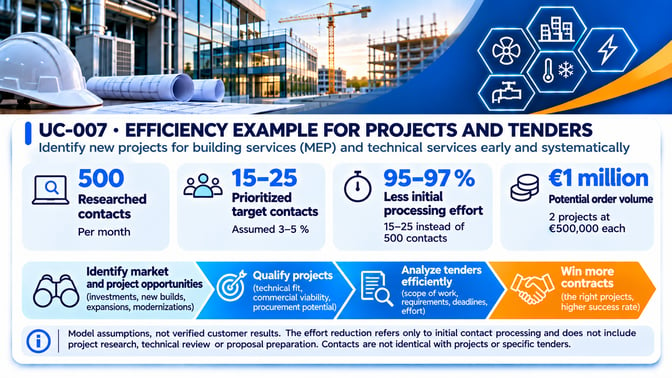
For an illustrative sales planning example, we’ll consider 500 researched contacts per month.
We assume that 3 to 5 percent of these can be identified as particularly relevant target contacts with a clear project connection.
This corresponds to 15 to 25 prioritized contacts per month.
This rate is a model assumption, not a proven performance metric.
It is also important to distinguish between contacts and projects: Multiple contacts can belong to a single project, and a company can pursue multiple projects simultaneously.
A prioritized target contact is also not a confirmed request for proposal or a sales opportunity that has already been secured.
It refers to a relevant market participant for whom a suitable project has been identified or for whom there is a concrete reason to conduct in-depth project research.
This makes sales efforts significantly more selective.
9. Why Even a Few Won Projects Can Be Economically Significant
In the field of technical building and industrial services, individual projects can reach substantial order volumes.
Let’s consider a simplified model calculation.
A building services company wins two additional projects within a year.
Each of these projects has an assumed contract value of 500,000 euros.
This results in an additional order volume of 1 million euros.
Assuming a model contribution margin of 20 percent, this corresponds to a contribution of 200,000 euros before other costs not included in this analysis.
These figures are illustrative assumptions and not verified sales results.
However, they demonstrate why identifying a smaller number of suitable projects can be more economically advantageous than responding to numerous general calls for bids.
The key metric is not the number of tenders identified.
What matters more is how many suitable projects actually become qualified sales opportunities and what financial success results from the contracts won.
10. The greatest effort is often required before submitting a bid
Successful project acquisition requires significant research.
Sales representatives must identify potential clients, gather project information, review technical requirements, and identify relevant stakeholders.
Added to this is the ongoing monitoring of the market.
Assuming 20 minutes of manual research per contact, 500 contacts would require approximately 167 working hours per month.
At an estimated labor cost of 60 euros per hour, this corresponds to a calculated monthly research cost of approximately 10,000 euros.
This model calculation includes neither a complete technical project evaluation nor the actual tender processing and bid preparation.
The latter, in particular, can tie up significant additional resources.
An efficient sales strategy must therefore address two key challenges.
First, suitable projects must be identified early on and systematically.
Second, a decision must be made regarding which projects are economically worthwhile to pursue in greater depth.
11. How AI-powered research identifies relevant projects in the market
This is where specialized research solutions like bloo.research can help.
The research begins with an analysis of the company’s own service portfolio.
What technical services does the company offer? Which project types, industries, and locations are of particular interest? What project sizes and requirements align with existing resources?
This information is used to create specific research profiles.
These profiles enable companies and projects to be systematically researched using publicly available information.
Relevant examples include investment announcements, site expansions, construction projects, project developments, and published calls for bids.
The research does not merely consider whether a company generally belongs to the target group.
What matters is whether there is a concrete connection between the company’s own service offering and a recognizable or emerging project need.
The standard package from bloo.research includes 500 researched contacts per month.
Assuming a model prioritization rate of 3 to 5 percent, this could result in 15 to 25 particularly relevant target contacts.
The specific availability and coverage of tender information depend on the accessible sources. Not every project or procurement process is publicly searchable.
The key advantage is that market monitoring and the initial screening of companies and projects can be carried out systematically.
The sales team can focus more of its time on evaluating relevant projects, approaching eligible contacts, and preparing promising proposals.
12. From Project Research to a Qualified Bid Decision
Identifying a suitable project is the first step.
Next, it must be determined whether preparing a bid makes sense from a technical, organizational, and economic standpoint.
This step can be particularly time-consuming when dealing with extensive scope of work documents, technical specifications, and numerous individual line items.
Specialized solutions such as bloo.bid can be used for the subsequent evaluation of specific bid documents.
While bloo.research assists with the identification and initial qualification of relevant companies and projects, bloo.bid focuses on analyzing existing bid documents and mapping service items.
This allows for the separation of two distinct tasks within the sales process.
Project research answers the question of which projects might be of interest to your company.
The bid analysis supports the subsequent evaluation of which requirements a specific bid contains and how they align with the company’s own service portfolio.
The technical, commercial, and public procurement law decisions remain with the company.
Conclusion: The best project opportunities don’t start with the tender
For providers of technical building systems and specialized services, there is significant market potential in projects that can be identified even before their formal tender is issued.
Investments, construction projects, site developments, and technical upgrades provide clues to potential future needs.
Those who systematically link this information to their own service portfolio can identify relevant projects earlier and plan their sales activities more effectively.
Published calls for bids remain an important source of information, but they are only one part of a broader market analysis.
The key is not to find as many calls for bids as possible.
The goal is to identify the right projects, assess their economic viability, and focus limited sales resources on the most promising initiatives.
AI-powered research with bloo.research can support this process and reduce the manual effort required to identify and initially qualify potential project opportunities.
What projects are currently emerging in your target market?
Find out which companies are planning new buildings, production facilities, or technical infrastructure—and for which projects your services might be in demand.
Learn more about bloo.research
Take action now
Try out this approach for yourself. In our meeting, we will show you how your sales team can harness the power of AI technology.