Share this
by Lars-Thorsten Sudmann on Nov 21, 2026, 10:27:55 AM
Why Materials, Machinery, and Machining Processes Are More Important Than the Industry Itself—and How This Leads to Long-Term Customer Relationships
Manufacturers of industrial cutting tools face a particular challenge when it comes to acquiring new customers.
Their products are used in numerous industries. Drills, milling cutters, reamers, threading tools, indexable inserts, and other precision tools are essential equipment in industrial manufacturing.
But not every metalworking company needs the same tools.
One company machines large aluminum components on modern five-axis milling machines. Another produces precision turned parts made of stainless steel. A third manufacturer produces complex components made of titanium or high-temperature-resistant alloys.
All three companies require cutting tools. However, their technical requirements differ significantly.
This raises a crucial question for the sales department:
Which companies process materials and components using manufacturing processes for which our tools are particularly well-suited?
Those who systematically analyze these relationships can identify new customers more effectively and build long-term supply relationships based on suitable tool applications.
1. Why traditional industry lists fail to identify actual tool requirements
Let’s take the example of a manufacturer of high-performance milling cutters for machining aluminum and stainless steel.
Traditional sales research might identify companies in the metalworking, mechanical engineering, and automotive supply industries.
But these industries encompass very different types of manufacturing operations.
One company primarily manufactures welded structures. Another operates numerous CNC machining centers for complex aluminum components. A third focuses on automated turning operations.
While the first company may only need milling tools occasionally, the second could be a particularly attractive customer for high-performance milling tools.
Even two companies with the same number of machines can have different requirements.
One facility manufactures simple parts from materials that are easy to machine. The other produces high-precision components with tight tolerances and demanding surface finishes.
Tool requirements are therefore not determined solely by the industry.
The decisive factors are the machining processes, materials, machines, part geometries, and quality requirements used.
A successful search for new customers must take precisely this information into account.
2. The Better Approach: From Your Own Tool Portfolio to the Right Manufacturing Process
A systematic search for new customers begins with an analysis of one’s own products and their potential applications.
What machining tasks can the tools perform? For which materials and machines are they suitable? What technical advantages do they offer under specific operating conditions?
For a manufacturer of industrial cutting tools, for example, the following product groups may be relevant:
- Twist drills, deep-hole drills, and specialty drills
- End mills, face mills, and high-performance mills
- Reamers and finishing tools
- Taps and thread milling cutters
- Turning tools and indexable inserts
- Grooving and forming tools
- Tools for difficult-to-machine materials
- Custom Special-Purpose and Combination Tools
Specific application conditions can be derived from these product groups.
For example, a manufacturer of high-performance milling cutters for aluminum is looking for companies that machine large quantities of aluminum components and have specific requirements regarding chip volume, surface finish, or process stability.
A supplier of reamers, on the other hand, focuses on manufacturers who need to produce bores with high dimensional and geometric accuracy.
A specialist in deep-hole drilling tools seeks companies whose components require deep holes with demanding requirements for chip removal, straightness, or surface finish.
This results in a process-oriented Ideal Customer Profile (ICP).
It is not the general industry but the specific relationship between the tool, the material, and the manufacturing process that determines a potential customer’s suitability.
3. Manufacturing processes reveal which tools are needed
Information about the actual manufacturing processes used is particularly valuable for finding new customers.
CNC milling and machining centers
Companies with three-, four-, or five-axis machining centers require different milling, drilling, and finishing tools.
Of particular interest here are the materials being machined, part sizes, geometric requirements, and production volumes.
A manufacturer of aluminum housings may require different milling tools than a company that machines high-strength steel components or titanium alloys.
CNC Turning and Turn-Mill Machining
Companies with CNC lathes and turn-mill centers regularly use turning tools, indexable inserts, drilling tools, and threading tools.
Economic viability depends, among other factors, on the materials being machined, production volumes, machine uptime, and process requirements.
Precision Drilling and Finishing
Manufacturers of hydraulic components, valve blocks, precision housings, or mechanical functional parts may require particularly precise boring operations.
In such cases, reamers, fine-boring tools, and specialized machining solutions may be relevant.
Machining of Difficult-to-Machine Materials
Companies that machine stainless steel, titanium, nickel-based alloys, or hardened materials often have specific requirements regarding cutting materials, coatings, tool geometries, and process control.
For specialized tool manufacturers, such companies can be attractive target customers.
These examples illustrate why actual manufacturing processes are far more revealing than general company information.
4. Tool requirements arise from the ongoing production process
A key difference from many other industrial products is that cutting tools must be replaced regularly.
Cutting edges wear out. Indexable inserts are replaced. Drills and end mills must be replaced or reground.
Tool requirements thus arise directly from the ongoing manufacturing process.
A company that uses multiple CNC machines in multi-shift operation may have significantly higher tool consumption than a facility with comparable machines that are used only occasionally.
This raises two questions for the sales department.
First: Which companies have production processes for which our tools are technically suitable?
Second: Which companies offer attractive recurring revenue potential based on their production volumes, machine runtime, and tooling requirements?
The second question is particularly important from a business perspective.
A technically suitable customer with continuous tool consumption can be significantly more attractive over several years than a company that only occasionally needs individual tools.
5. The need already exists. The key question is why a customer should switch suppliers.
Most industrial manufacturing companies already source their cutting tools from existing suppliers.
A new tool manufacturer therefore does not necessarily have to create new demand.
They must demonstrate why their products could offer a better technical or economic solution for specific machining tasks.
Possible selling points include longer tool life, higher cutting speeds, shorter machining times, or improved process stability.
Reduced tool-changing effort, better surface quality, more reliable delivery, or a reduction in the number of tool variants can also be relevant.
The economic comparison should therefore not be based solely on the purchase price of a tool.
The total tooling and machining costs per manufactured part are decisive.
A higher-priced tool can make economic sense if it reduces machining time, can be used for a longer period, or results in less scrap.
Whether these benefits are actually achieved must be tested under the customer’s specific production conditions.
The research should therefore focus particularly on companies whose manufacturing processes align with the specific strengths of the supplier’s own tool portfolio.
6. Case Study: Identifying New Customers for High-Performance Milling Cutters
A medium-sized tool manufacturer offers high-performance end mills for machining aluminum and stainless steel.
The tools are designed for specific machining strategies and demanding industrial applications.
To date, the company has acquired new customers primarily through its technical sales force, distributors, existing contacts, and referrals.
To systematically seek out new customers, the company first examines which manufacturing processes could benefit most from its tools.
Of interest, for example, are companies with extensive CNC milling operations, modern machining centers, and a high proportion of relevant materials.
The research examines, among other things:
- Which companies use CNC milling on a large scale
- Which components and products are manufactured
- Which materials are regularly machined
- What machines and machining technologies are available
- Whether there are indications of mass production or high machine operating times
- Whether new manufacturing capacities or machining processes are being introduced
- Which departments are responsible for manufacturing, work planning, and tool procurement
The result is a selection of manufacturing companies where the use of the offered milling tools is technically feasible.
The sales team can then discuss the specific machining tasks in detail.
Instead of a general product presentation, a discussion ensues about tool usage, tool life, cutting parameters, machining times, and potential improvements in the manufacturing process.
7. Why Annual Tool Consumption Determines Customer Value
With cutting tools, a significant portion of the economic potential comes from regular reorders.
A company with extensive CNC manufacturing may have a continuous need for end mills, drills, indexable inserts, and other tools.
The actual volume depends, among other things, on the number of machines, utilization rates, materials, manufacturing processes, and tool life.
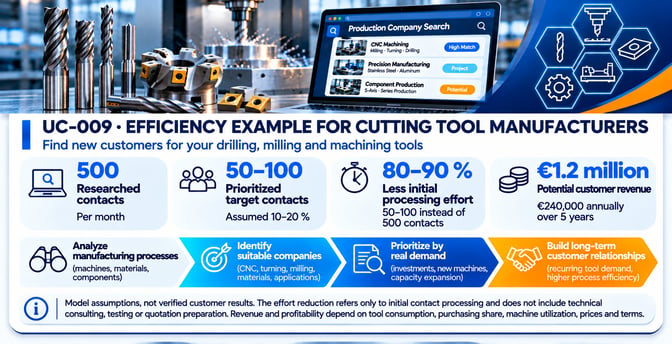
Sample calculation: A new customer with 40 CNC machines
A manufacturing company operates 40 CNC machines.
For this model calculation, we assume that tools worth an average of 500 euros per machine are purchased monthly from a specific supplier.
This results in a monthly revenue of 20,000 euros.
Projected over a year, this amounts to 240,000 euros.
If the supplier relationship remains constant for five years, this results in a calculated customer revenue potential of 1.2 million euros.
These figures are model assumptions, not universally applicable tool consumption values or verified customer results.
The actual achievable revenue depends on which tool groups are supplied, what share of the supply the provider achieves, and how machine uptime, prices, and tool consumption develop.
However, the calculation demonstrates why a single manufacturing customer with continuous production operations can be economically attractive in the long term.
8. Not every CNC operation is automatically a good target customer
A company may, in principle, require cutting tools and yet still be of little economic interest.
Therefore, several factors should be considered during the qualification process.
Technical tool compatibility
Do the company’s own tools match the manufacturing processes, materials, machines, and machining tasks used?
Tool Wear and Machine Uptime
How extensive is the machine fleet, and how intensively are the machines used?
A large machine fleet alone says little about actual tool wear.
Economic Optimization Potential
Are there machining tasks where longer tool life, greater process stability, or shorter machining times could generate significant economic benefits?
Supplier and Switching Potential
Are there valid reasons why a company might consider evaluating additional tool suppliers?
These include, for example, new manufacturing processes, special tool requirements, or changes in procurement strategy.
Support and Application Effort
What level of technical support is required to successfully use the tools?
Especially for demanding machining processes, application testing, cutting data optimization, and training may be required.
Long-Term Customer Value
What recurring revenue and contribution margin could result if the tools are successfully integrated into the production process?
Particularly attractive target customers combine a high technical fit with regular tool requirements and support costs that make economic sense.
9. Select the 50 to 100 most promising contacts from the 500 identified
The systematic research can initially examine a larger group of metalworking companies.
These are then prioritized based on their manufacturing processes, materials, machinery, and potential tooling requirements.
Let’s assume a tool manufacturer researches 500 potential contacts each month.
For illustrative sales planning purposes, we’ll assume that 10 to 20 percent of these are a particularly good fit for the company’s own tool portfolio and could represent economically attractive sales potential.
This corresponds to 50 to 100 prioritized contacts per month.
Extrapolated over a year, this results in a theoretical potential of 600 to 1,200 prioritized contacts.
This rate is a planning assumption and not a proven performance metric.
For tools with broad applications, the proportion of suitable companies may be higher than for highly specialized tooling solutions.
Furthermore, a prioritized contact does not yet constitute a confirmed procurement need or an acquired customer.
It refers to a company where a targeted review of tool applications is particularly worthwhile.
10. Use new manufacturing processes and machine investments as indicators of demand
The need for cutting tools often arises during ongoing operations.
However, changes in production processes can create additional sales opportunities.
For example, a company may invest in new five-axis machining centers.
Another company may take on the production of new component groups or expand its range of materials.
Such developments can lead to a need for new tools or a review of existing tooling concepts.
Points to consider include:
- Acquisition of new CNC machines and machining centers
- Expansion of turning or milling capacities
- Introduction of new materials and component groups
- Transition to automated machining processes
- Establishment of additional production sites
- Introduction of new generations of machines or products
- Higher requirements for precision and surface quality
- Optimization of machining times and manufacturing costs
- Changes in tool procurement or supplier structure
This information does not yet constitute a confirmed intention to purchase.
However, it provides concrete opportunities for a technically sound approach to the customer.
The timing can be particularly interesting when a company is planning new machining processes and selecting the tools to be used for the first time.
11. The right contact person understands the manufacturing process
When it comes to industrial cutting tools, the decision to purchase is often influenced by several factors.
Production management evaluates productivity and process stability.
Work preparation and production planning define machining strategies and tool requirements.
CNC programmers and application engineers evaluate cutting data, tool geometries, and practical applications.
The technical purchasing department decides on suppliers, terms, and procurement processes.
For a successful approach, therefore, the right role must be matched to the specific manufacturing requirements.
A general offer for milling cutters or drill bits often provides little basis for discussion.
A sales pitch that focuses on the material, the machining task, or a potential improvement to the manufacturing process is significantly more relevant.
This allows a tool manufacturer to demonstrate, even during the initial conversation, why its product might be of interest for the specific application.
12. How Better Target Customer Selection Reduces Sales Effort
Acquiring new tooling customers often requires a technical evaluation of the manufacturing processes.
Before a test or quote makes sense, it is necessary to understand the materials being machined, the machines, the tool applications, and the economic requirements.
Therefore, it makes sense to weed out unsuitable companies early on.
Let’s look at a sample calculation.
On average, a sales representative needs 30 minutes to prepare for and make initial contact with a potential customer.
With 500 contacts, that would amount to 250 work hours.
If the sales team focuses on 50 to 100 prioritized contacts, this comparable workload is reduced to 25 to 50 hours.
This corresponds to a calculated reduction of 80 to 90 percent.
This does not include the preliminary research and qualification, as well as subsequent application tests, technical discussions, and quotes.
For particularly attractive prospects, the effort per contact may be higher.
The advantage is that the technical sales team can devote more time to companies where their own tools actually fit the manufacturing process and where a relevant economic benefit can be expected.
13. The Real Challenge: Conducting Cost-Effective Research on Manufacturing Processes
The procedure described can, in principle, be carried out manually.
To do so, sales representatives would have to examine numerous manufacturing companies, analyze their product portfolios, identify machining processes, and determine potential tooling requirements.
In addition, they would need to research machine fleets, materials, and potential changes in manufacturing processes.
This is a time-consuming process.
Assuming 20 minutes of manual research per contact, 500 contacts would require approximately 167 working hours per month.
At an estimated labor cost of 60 euros per hour, this corresponds to a monthly research cost of approximately 10,000 euros.
This model calculation does not yet take into account an in-depth technical review.
Furthermore, information about the tools actually used, tool consumption, and machining parameters is often not publicly available.
Technical validation during a customer consultation therefore remains necessary.
The challenge lies in identifying, even before this assessment, those manufacturing companies whose processes are particularly well-suited to one’s own tool portfolio.
14. How AI-powered research identifies suitable tooling customers
This is where specialized research solutions such as bloo.research can help.
The research begins with an analysis of the company’s own tool portfolio.
What tools are available? For which materials, machining processes, and technical requirements are they suitable? In which applications do they have particular strengths?
This leads to the creation of specific search profiles.
Subsequently, companies can be identified whose products, manufacturing processes, and publicly visible production structures meet these criteria.
Factors such as CNC milling and turning, materials, component groups, production capacities, and published investment plans can be taken into account.
The standard bloo.research package includes 500 researched contacts per month.
Assuming a model prioritization rate of 10 to 20 percent, this could result in 50 to 100 particularly interesting target contacts.
The key advantage is that large parts of the company research and initial qualification can be carried out systematically.
The sales team does not have to research every company from scratch and can focus more on specific tool applications, technical discussions with customers, and the development of long-term supplier relationships.
Whether a tool actually offers economic benefits must be evaluated under the specific manufacturing conditions.
The previously calculated 167 hours of manual research serve as a benchmark. The actual time savings depend on the previous research process and the validation effort required.
Conclusion: The best tool customers can be identified by their manufacturing processes
For manufacturers of industrial cutting tools, there is significant market potential among companies whose manufacturing processes regularly require suitable tools.
These companies cannot be reliably identified based solely on their industry sector.
The decisive factors are the machines used, the materials being machined, component requirements, and manufacturing processes.
Those who systematically analyze these relationships can identify new customers for whom their own tool portfolio is a particularly good fit, both technically and economically.
A key advantage lies in recurring demand.
If a tool is successfully integrated into a production process, this can lead to regular orders and long-term customer relationships.
AI-powered research helps systematically identify these potential customers and reduce the effort required for manual research.
Which manufacturing companies need your tools?
Find out which companies use production processes, materials, and machines for which your cutting tools might be particularly well-suited.
Learn more about bloo.research
Take action now
Try out this approach for yourself. In our meeting, we will show you how your sales team can harness the power of AI technology.