Two companies are in the same industry.
They are similar in size.
They produce comparable products.
And yet, every sales meeting unfolds completely differently.
The first company is investing in a new production line.
The second is struggling with a shortage of skilled workers.
Two companies are in the same industry.
They are similar in size.
They produce comparable products.
And yet, every sales meeting unfolds completely differently.
The first company is investing in a new production line.
The second is struggling with a shortage of skilled workers.
The third is pursuing an international growth strategy.
The fourth wants to reduce its energy costs.
From the outside, these companies look similar.
Internally, however, they differ significantly.
That is precisely why Commercial Intelligence does not stop at the market, target audience, or demand.
It focuses on the individual company.
What is Account Intelligence?
Account Intelligence describes the systematic analysis of a specific company.
The key question is:
What do we need to know about this company to make our sales efforts successful?
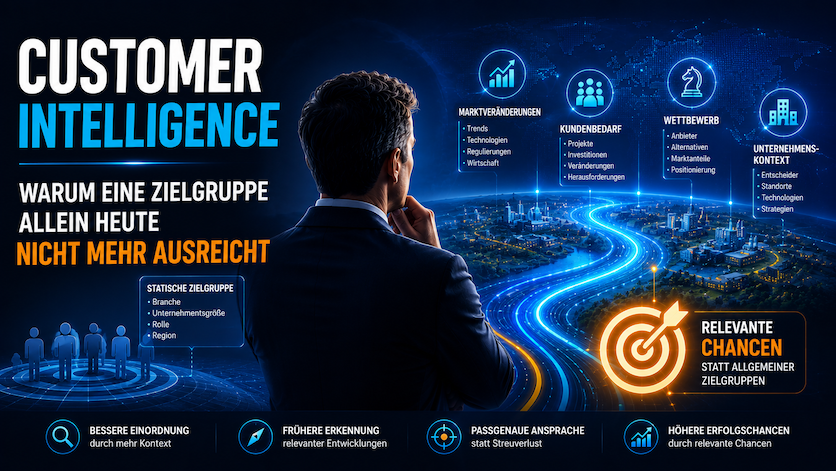
While Customer Intelligence describes the ideal customer type, Account Intelligence focuses on a specific company.
It provides the specific context that transforms a general opportunity into a concrete sales approach.
Every company has its own history
Companies do not make their decisions based solely on numbers.
They act within the context of their own situation.
That’s why Account Intelligence examines, for example:
- ongoing projects,
- investment plans,
- corporate strategy,
- locations,
- production processes,
- technologies used,
- existing suppliers,
- organizational structure,
- ownership structure,
- sustainability goals,
- international activities,
- partnerships,
- public statements by management.
Only this information explains why a company makes certain decisions and what challenges are actually at the heart of its operations.
People make decisions
Even in B2B sales, it’s not companies that make the purchases.
People make decisions.
That’s why understanding the decision-makers is also part of account intelligence.
These include, among others:
- Subject-matter experts,
- technical contacts,
- purchasing,
- executive management,
- project managers,
- Plant Managers,
- Innovation teams,
- external consultants.
Each of these individuals has different goals.
Knowing only the decision-maker is far from enough to understand the decision-making process.
Account Intelligence helps make these connections visible.
Personalization starts with understanding
Many companies today talk about personalized sales.
Often, this simply means replacing the company name or the contact person in an email.
True personalization begins much earlier.
It arises from understanding a company’s business context.
A company that is currently building a new plant needs to be addressed differently than a company that wants to modernize its existing production facilities.
A CEO is interested in different selling points than a production manager.
A purchasing manager evaluates a solution differently than a technical manager.
The better this context is understood, the more relevant the communication becomes.
Account Intelligence turns information into conversations
The previous components of Commercial Intelligence answer strategic questions.
Market Intelligence explains the market.
Customer Intelligence defines the right type of customer.
Demand Intelligence reveals current needs.
Competitive Intelligence describes the competitive landscape.
Finally, Account Intelligence answers the operational question:
How do we specifically approach this company?
It provides the context for personalized conversations, relevant arguments, and a tailored sales strategy.
The Role Within Commercial Intelligence
Account Intelligence bridges the gap between analysis and sales.
It ensures that an opportunity doesn’t remain abstract.
Instead of a list of companies, it fosters a deep understanding of each individual account.
This enables the sales team to:
- prepare for meetings in a more targeted way,
- identify relevant contacts,
- develop customized pitches,
- better anticipate objections,
- and build trust much more quickly.
This is exactly what turns an opportunity into a concrete sales approach.
Conclusion
Account Intelligence doesn’t answer the question of whether a company is a good fit.
It answers the question of how that company thinks, makes decisions, and acts.
It is this understanding that transforms general market information into personalized sales.
After all, successful sales work doesn’t start with a product.
It begins with understanding the company you’re speaking with.
Outlook
This article completes the description of the five components of Commercial Intelligence. In the next post, we’ll bring them together and show how Market Intelligence, Customer Intelligence, Demand Intelligence, Competitive Intelligence, and Account Intelligence—when intelligently linked—give rise to Opportunity Intelligence, thereby laying the foundation for better sales decisions.
If you want to not only understand AI but also implement it systematically in your company, then: